
International Space Station (ISS)
Review conditions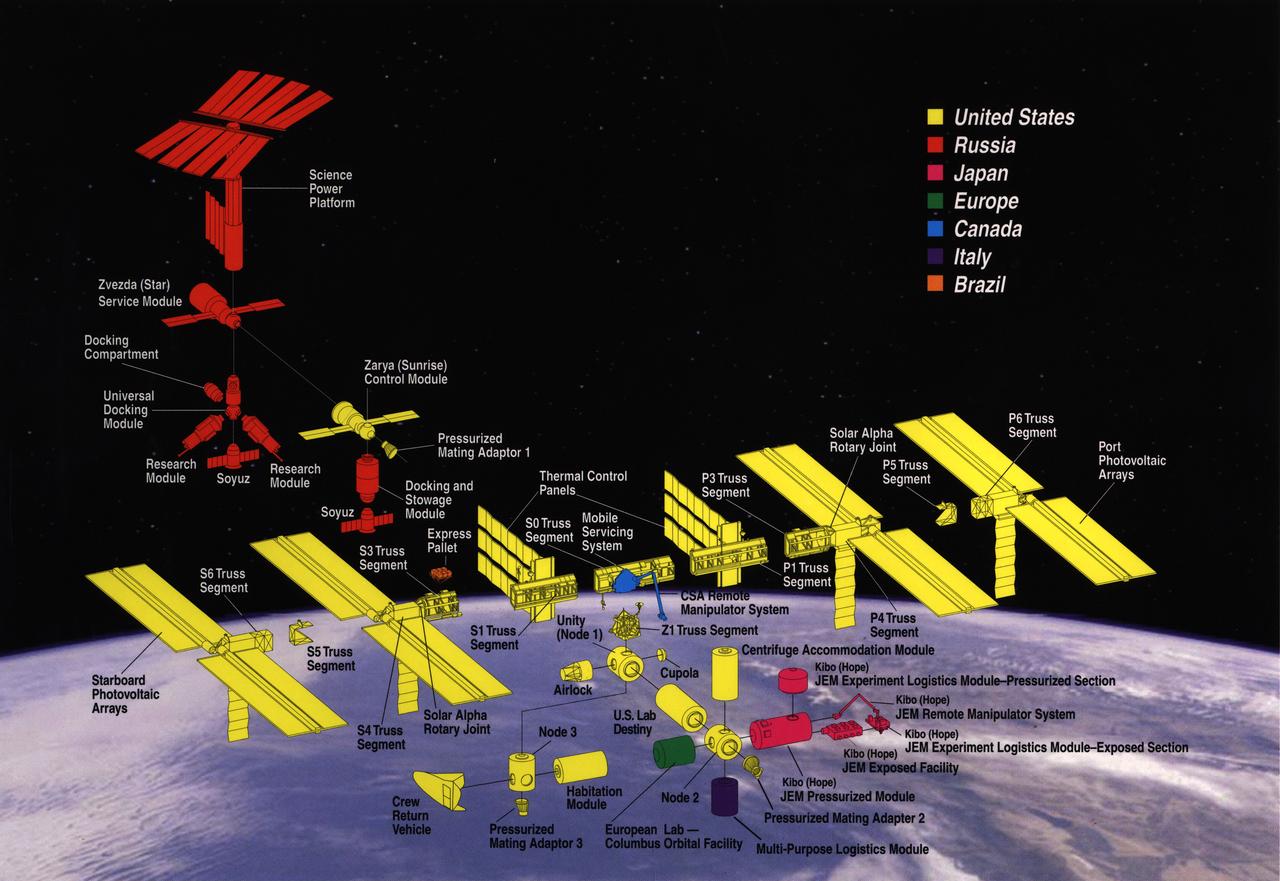
The International Space Station (ISS) is an unparalleled international scientific and technological cooperative venture that will usher in a new era of human space exploration and research and provide benefits to people on Earth. On-Orbit assembly began on November 20, 1998, with the launch of the first ISS component, Zarya, on a Russian Proton rocket. The Space Shuttle followed on December 4, 1998, carrying the U.S.-built Unity cornecting Module. Sixteen nations are participating in the ISS program: the United States, Canada, Japan, Russia, Brazil, Belgium, Denmark, France, Germany, Italy, the Netherlands, Norway, Spain, Sweden, Switzerland, and the United Kingdom. The ISS will include six laboratories and be four times larger and more capable than any previous space station. The United States provides two laboratories (United States Laboratory and Centrifuge Accommodation Module) and a habitation module. There will be two Russian research modules, one Japanese laboratory, referred to as the Japanese Experiment Module (JEM), and one European Space Agency (ESA) laboratory called the Columbus Orbital Facility (COF). The station's internal volume will be roughly equivalent to the pas
Rights evidence
NASA media-use guidance applies; NASA identifiers, endorsement, third-party material, and personality rights require separate review.
International Space Station (ISS). Credit: NASA / MSFC.
Normalized by rights-v2-discovery. This is evidence routing, not legal advice.