
International Space Station (ISS)
Review conditions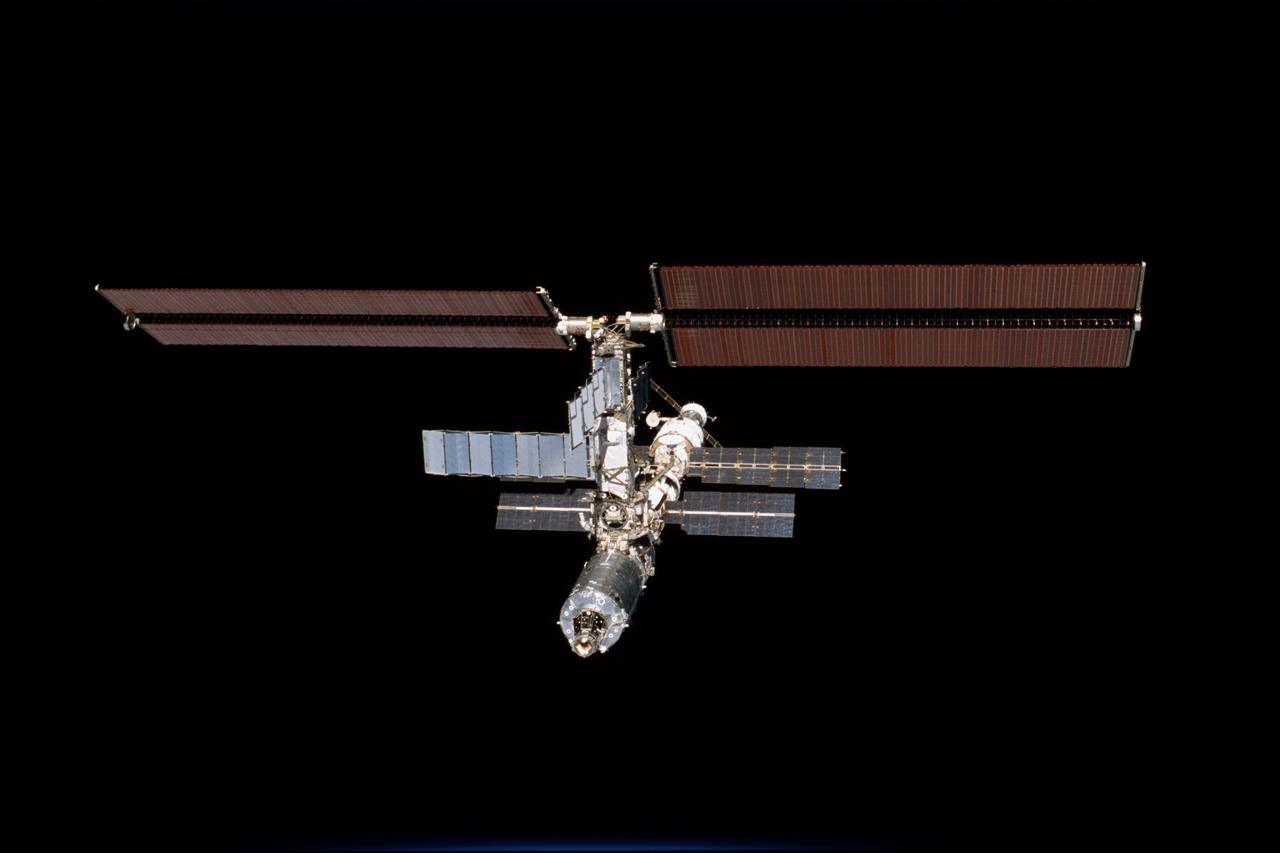
The International Space Station (ISS), with its newly attached U.S. Laboratory, Destiny, was photographed by a crew member aboard the Space Shuttle Orbiter Atlantis during a fly-around inspection after Atlantis separated from the Space Station. The Laboratory is shown in the foreground of this photograph. The American-made Destiny module is the cornerstone for space-based research aboard the orbiting platform and the centerpiece of the International Space Station (ISS), where unprecedented science experiments will be performed in the near-zero gravity of space. Destiny will also serve as the command and control center for the ISS. The aluminum module is 8.5-meters (28-feet) long and 4.3-meters (14-feet) in diameter. The laboratory consists of three cylindrical sections and two endcones with hatches that will be mated to other station components. A 50.9-centimeter (20-inch-) diameter window is located on one side of the center module segment. This pressurized module is designed to accommodate pressurized payloads. It has a capacity of 24 rack locations. Payload racks will occupy 15 locations especially designed to support experiments. The Destiny module was built by the Boeing Compa
Rights evidence
NASA media-use guidance applies; NASA identifiers, endorsement, third-party material, and personality rights require separate review.
International Space Station (ISS). Credit: NASA / MSFC.
Normalized by rights-v2-discovery. This is evidence routing, not legal advice.