
Reading Market Street, 1906: a source-first film research note
A practical way to turn an archival film into a useful research note: separate what the image shows, what the institution says and what still needs checking.
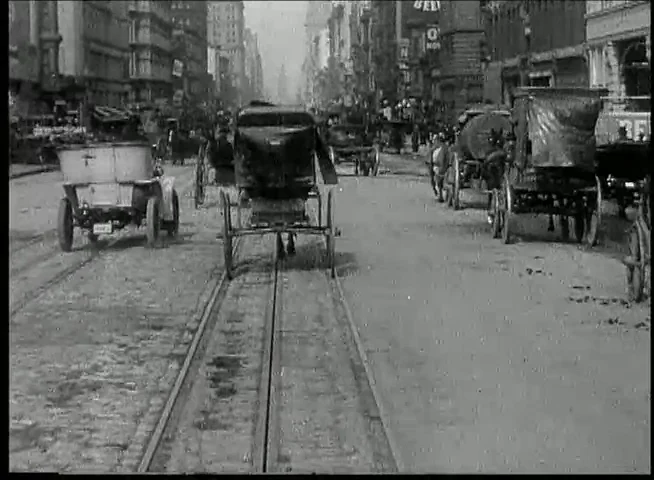
A preview still from the linked Market Street source film, available through Wikimedia Commons.
Preview still from the linked film · Wikimedia Commons ↗ · Date not verified
Source material & rights
A Trip Down Market Street
Public domainMarked Public domain on the Wikimedia Commons source record.
Open archive record & rightsA film can be a valuable primary source without explaining itself. Before using a shot as evidence, keep three things apart: your observation, the archive’s description and your interpretation. A compelling image should start a research question, rather than silently settle it.
Start with the catalog, then watch
The Library of Congress catalogs A trip down Market Street before the fire as a 1906 Miles Brothers film. Its description places the camera on a moving cable car in San Francisco. Use that institution record as a starting reference, and follow its notes and collection context rather than treating a repost’s title as the complete provenance.
PastTrace links an existing source copy below. The viewing copy and the Library of Congress reference may differ in their transfer, edit, runtime or playback speed. Matching the title does not prove that two digital files are identical. If you compare copies, record which file you actually watched.
Watch the source copy, and review its record and rights before reuse.
Wikimedia Commons ↗ · Date not verified
Source material & rights
A Trip Down Market Street
Public domainMarked Public domain on the Wikimedia Commons source record.
Open archive record & rightsWrite a two-column observation note
On one side, write only what you can see in the selected interval: a vehicle enters the frame, people cross the street, or a sign is legible. On the other, record interpretations that need corroboration. A visible building or vehicle may help a later identification, but it does not establish a precise filming day by itself.
- Preserve the source title, institution and identifier.
- Note the playback copy and start/end timecodes.
- Separate a catalog statement from a personal inference.
- Mark an unreadable sign or unidentified person as unknown.
Keep an excerpt attached to its parent
A few seconds can omit what happens just before or after the cut. Watch surrounding footage before writing a caption. If an eligible file works in PastTrace Clip Maker, retain the original film link and selected timecodes with the exported clip. Creating an MP4 does not establish ownership or permission to reuse it.
The source record’s historical date and a website’s upload date answer different questions. Keep the original date statement in your notes; do not turn a broad or approximate period into a precise date simply because an editing template expects one.
Save a research package, not just a download
Keep the original archive URL, the consulted copy, a citation, your observation note and the relevant rights statement together. PastTrace’s citation exports and source links help keep that trail attached to the material. The originating institution remains the reference for its own metadata and rights evidence.
Before publishing a documentary caption, check each historical claim against its supporting source. If the evidence does not support the claim, narrow the wording or leave the question open. This is more useful to the next researcher than a confident caption without a trail back to the archive.
Sources & further reading
Articles provide editorial context; the original institution record remains the reference for item metadata and rights. Suggest a source-backed correction.