
القدس قبل عام 1948
مواد تطابق القدس ويشير تاريخها أو نطاقها الزمني إلى فترة تتقاطع مع ما قبل 1948. ذكر المكان لا يثبت موقع التصوير، والتواريخ التقريبية تظل تقريبية.
410 سجلًا مطابقًا؛ الأوصاف والعناوين الأصلية محفوظة. البحث والمرشحات →
التحقق من الأدلة · توثيق المادة والمقطع · الحقوق


Die von einer himmlisch-gesinnten Seele Jn Gesang und Gebet Gesuchte Erquick-Stunden

Frommer Hertz-Christen Bester und gröster Schatz, Das ist: Das Trost-reiche Psalmen-Buch Davids

Geistliches Neu-vermehrtes Altenburgisches Gesang- und Gebet-Buch : Jn sich haltend den Kern Alter und Neuer geistreichen Lieder und Gesänge D. Martin Luthers und Anderer Christlichen Lehrer und frommer Christen

[Prezentarea lui Isus la Templu]
http://vocab.getty.edu/aat/300021477 Angelo Campanella a gravat după o compoziție pictată în 1516 de călugărul dominican Fra Bartolomeo, pentru mănăstirea San Marco din Florența. Compoziția este inspirată din Evanghelia Sf. Luca (II, 22). Central, Marele Preot al Templului primește în brațele sale Pruncul, prezentat de Sf. Maria și de Sf. Iosif. Două femei, dintre care una îngenuncheată, contemplă Pruncul. stil: Neoclasicism inscripție [Latină]: Semnat sub cadru, în stânga: „Fra Bartolomeo di S. Marco pinxit” și în dreapta: „Ang. Campanella sculpsit Romae 1771”. Central, inscripția: „Venerunt in Jerusalem, ut sisterent eum Domino S. Luc. Cap. II v. 22”; „Florentiae in Sacrario S. Marci”. În dreapta, sus, cifra 6.

Altmärkisch- und Priegnitzisches Neu-eingerichtetes Gesangbuch : Darinnen sowol die ältesten des sel. D. Lutheri und anderer ... Als auch einige Neue Geistreiche Gesänge befindlich, zum Gebrauch der Kirchen, bey dem öffentlichen Gottes-Dienst, besonders in der Alten Mark und Prignitz eingerichtet : mit allem Fleiß ... zusammen getragen, und mit einem Gebet-Büchlein samt den gewöhnl. Collecten, wie auch Sechsfachem Register und einer Erklärung einiger fremden und unbekandt gewordenen deutschen Wörter, versehen

WAR PICTORIAL NEWS, NO. 217 [JULY 2]
National Archives and Records Administration - ARC 39218, LI 208-WP-217 - WAR PICTORIAL NEWS, NO. 217 [JULY 2] - DVD Copied by Ann Galloway. Series: Motion Picture Films from "War Pictorial News" Newsreels, compiled 1943 - 1945. Part 1, pipe, to be laid across the English Channel for the transportation of petroleum, is prepared in England. The Brit. ship Conundrum starts "Operation Pluto" by laying pipe sections in the channel. Shows a pumping station. Oil-burning tanks advance; flaming oil is used to lift fog from an airstrip; planes land and take off. Part 2, repatriated Indian prisoners debark at a port in India; stretcher cases are carried ashore and treated by Red Cross nurses. Part 3, Viscount Gort and other officials review a Brit. military parade in Jerusalem honoring King George VI; RAF squadrons fly overhead.

Les aventures des «Sarrasins» francais de Bourgogne au XVe siècle
Volumul conține ca documente anexă Raportul burgund despre luptătorii din cruciada Rodosului, în Marea Neagră și coasta barbară (Bibl. Nationale de Paris, français 1278, fol.127-129; edition de Mlle Dupont, Anchiennes Cronicques d'Engleterre par Jehan d Comunicarea este o cronică a expedițiilor cavalerilor francezi, în lupta antiotomană, expediții atât pe Dunăre în contextul bătăliilor purtate de Iancu de Hunedoara, cât și al celor purtate în insula Cipru. Pentru expedițiile dunărene sursa folosită a fost cronica lui Wavrin.

Sukkah
In the 19th century, Naftali and Zili Deller commissioned a local painter to paint the walls of their sukkah. Their son Abraham Deller and his wife Sofie erected the sukkah in the courtyard of their home in Germany every year until the Nazis came to power. In 1937 the sukkah was smuggled out of Germany and delivered to the Bezalel Museum in Jerusalem. The central wall features a painting of Jerusalem with the Western Wall at its hub. This painting was copied from a lithograph by 19th-century Jerusalem artist Yehosef Schwartz. The other walls contain pictures of the village of Fischach and people from that period: on the right is Zili Deller waiting at the entrance to her home; on the back wall is the local baron, the patron of the village Jews, setting out to hunt. Painted within small frames in the background of the central and right-hand walls are depictions of Jewish holidays copied from prayer books printed in Sulzbach, Germany, in 1826.

Neueingerichtetes Evangelischlutherisches Gesangbuch : welches nach der Ordnung des Heils die Christlichen Glaubenslehren und Lebenspflichten in sich enthält, zum Gebrauch sämtlicher Evangelischlutherischen Gemeinden des Saalkreises und der Grafschaft Mannßfeld Magdeburgischer Hoheit

Elijah's chair
According to Jewish tradition, the Prophet Elijah is present at every circumcision, protecting the baby boy. And so “Elijah’s Chair” is the name given to the seat of the godfather who holds the infant during this ceremony. The Elijah’s Chair seen here is one of the most sumptuous items produced by the Bezalel School founded in Jerusalem in 1906. It took several years to create, with artisans from all of the school’s workshops participating in the project. Bezalel’s goal was to create an artistic language that would instill national spirit, through the use of Zionist symbols and themes from the Bible and the Land of Israel. In this way, the early Zionists identified with Jewish history as both a religious and a national tradition, and linked the Jewish nation’s future to its past in biblical times. The chair’s regal decoration features appropriate biblical scenes, emblems of the twelve tribes, and cherubs in classic Bezalel style. It is fitting that a chair/altar designed as a symbol of Jewish national revival should be used for the rite of circumcision, which symbolizes the ongoing covenant between God and the Jews.

Kinder Postilla Vber die Sontags, vnd der fürnembsten Fest Euangelia, durch das gantze Jar / Gestellet durch M. Vitum Dieterich [...].
2 ° [10], CCCXXXIIII k. Includes woodcut illustrations Frame: Brown skin, gilded stamping, a piece of work, a plaque with the scene of Crucifixion, fittings, remnants of clasps, edges of cards gilded, cised Provenance: Frederick IV (Duke of Legnica, 1552-1596) Provincial Library of Prince Jerzy Rudolf (Legnica) 2° [10], CCCXXXIIII k. Zawiera ilustracje drzeworytowe Oprawa: Skóra brązowa, tłoczenia złocone, radełka, plakieta ze sceną Ukrzyżowania, okucia, resztki klamer, brzegi kart złocone, cyzelowane S. tyt. czerwono-czarna z drzeworytem (Przemienienie na Górze Tabor) oraz datą: M.D.LXV. Proweniencja: Fryderyk IV (książę legnicki ; 1552-1596) Proweniencja: Biblioteka księcia Jerzego Rudolfa (Legnica)

An Allegorical Wedding: Sketch for a carpet dedicated to Mr. and Mrs. David Wolffsohn Triptych (from right to left): Exile, Marriage, Redemption
This triptych was created by one of the founders of the Bezalel School of Arts and Crafts in Jerusalem: the graphic artist Ephraim Moses Lilien, who is regarded as the leading formulator of Zionism’s artistic vision in the early 20th century. It is a sketch for a carpet that was to be woven at Bezalel in honor of the 25th wedding anniversary of David Wolffsohn, president of the World Zionist Organization and heir to Theodor Herzl. At the right Exile is represented by Jeremiah, the biblical prophet who foretold the destruction of Jerusalem, while the left-hand panel shows Redemption. In the center are the bride and groom: he is portrayed as a blend of the Assyrian king Tiglath-Pileser and portraits of Herzl and Wolffsohn himself; she is an icon of the virtuous Jewish woman. Their wedding ceremony symbolizes the merging of the Zionist ideal with the Jewish people, while the entire triptych spans all of Jewish history, from biblical sovereignty to modern Zionist redemption. Lilien asserts that the Jews are the true heirs of the ancient civilizations that were being rediscovered in his time, thanks to archaeological finds. His royal couple is noble and proud, the opposite of stereotypical frail, downtrodden Diaspora Jews.
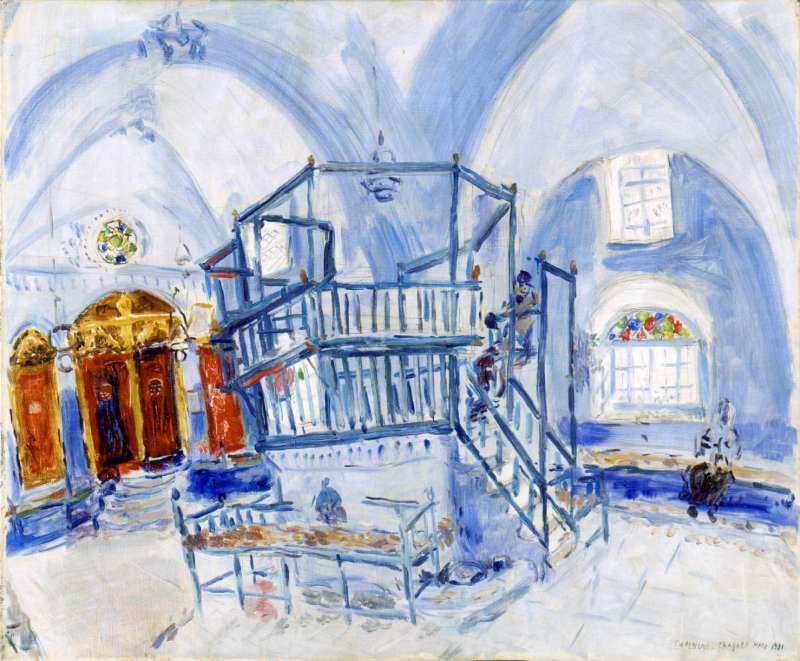
Interior of a Synagogue in Safed
Chagall visited Israel eight times, frequently in connection with monumental projects in Jerusalem, such as his twelve stained-glass windows for the synagogue of the Hadassah hospital (1960–62) and his large tapestries and floor and wall mosaics for the Knesset building (1965–69). According to the artist, however, it was his first visit, made in 1931 with his wife, Bella, and young daughter, Ida, that left the most vivid impression. During their three-month stay, Chagall worked incessantly, recording his impressions of Tel Aviv, Jerusalem, and Safed. While in Safed, he painted several views of synagogue interiors. Interior of a Synagogue in Safed employs color and spatial distortion to create a mood of spirituality. The work is dominated by a pale blue luminosity, reflective of the strong sunlight pouring into the building and broken only by the saturated red-brown hues of the ark curtains and the flower motifs in the two visible stained-glass windows. The Ari Sephardic Synagogue still stands today, looking much as it did when Chagall fixed its image on canvas. This painting is one of the few works in Chagall’s oeuvre that describe a place that actually exists and thus can be thought of as a “document.” But it also serves as evidence of Chagall’s artistic encounter with a new world and its new, overwhelming light.
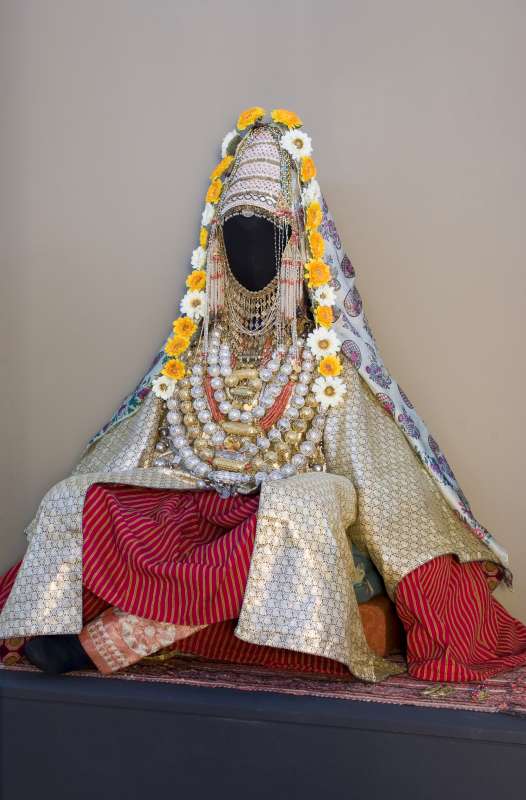
Jewish bride from Sana'a, Yemen
Unlike her counterparts in other areas of Yemen, the Jewish bride from Sana’a looked like a dazzling piece of jewelry herself. She wore a tall tiara adorned with pearls (“tishbuk lulu”) and surrounded by a row of sweet-scented flowers. A green silk scarf (“wardiyyeh”) hanging from the top of the tiara flowed down her back, and sprigs of basil and rue (“ambar”) were attached to her temples to ward off the evil eye. Triangular filigree pendants with long pearl chains hung from either side of the tiara, against the bride’s temples, and a “labbeh” necklace framed her chin. Beneath the labbeh, her chest was decorated with rows of beaded necklaces worn in a set order. Most of the necklaces were made of hollow silver or gilt-silver spheres (“dugag”); others were made of threaded coral beads (“‘agd mirjan”) and pearls (“ma’nageh lulu”). Each necklace had an amulet container (“kutub”) in the center. Under the set of necklaces was a chain of bells (“hijaleh”), used by Muslim women as a belt. Under the jewelry that bedecked her, the bride wore a woven coat (“jallayah mizahhar”), two underdresses, and trousers with embroidered leggings. This embroidery, together with the components of the tiara, are what distinguished her from Muslim brides. Reconstruction: Aviva Muller-Lancet and Aliya Ben-Ami, the Israel Museum; Rabbanit Bracha Qafih and the Zadok family, Jerusalem
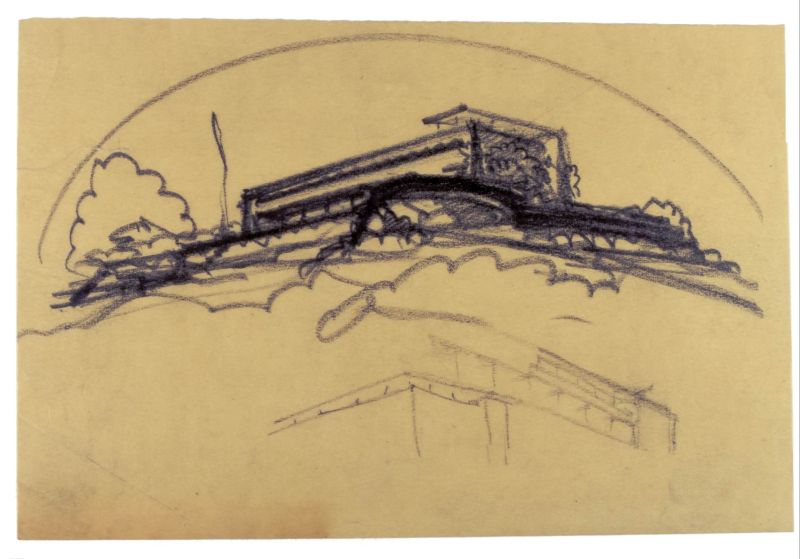
The Schocken House
Erich Mendelsohn is one of the most prominent architects of Modernism. He studied at the Technische Hochschule in Berlin and by the late 1920s his Berlin office was one of the largest and most successful in Europe. His early work - expressive, dynamic, and sculptural - is exemplified by the famous Einstein Tower observatory in Potsdam (1920-24). Among his clients was the publisher and businessman Salman Schocken, for whom Mendelsohn designed three large department stores. In 1933, with the rise of the Nazis to power, the architect left Germany and opened an office in London and, in 1935, a branch office in Jerusalem. He lived in Jerusalem from 1939 to 1941 and then settled in the United States. Among his important Jerusalem projects are Hadassah Hospital on Mount Scopus, the Anglo-Palestine Bank, and the Schocken House and nearby Library. The Schocken House demonstrates Mendelsohn's shift in the 1930s toward a more functional, restrained architecture, yet the drawing, showing an early stage of the design in bold and expressive lines, still echoes his early style. Taking local considerations into account, he used narrow windows to keep out the hot sun and stone walls in conformity with the building code introduced by the British. The building was later acquired by the Rubin Academy of Music; unfortunately subsequent additions and alterations changed the original design completely. This sketch is one of nine previously known drawings from the estate of Uriel Kahana, an architect who worked in Mendelsohn's, Jerusalem office.

1930 Survey of Palestine map of Jaffa-Tel Aviv.jpg
1930 Survey of Palestine map of Jaffa-Tel Aviv. For context, see: Tamir Goren (2016): Tel Aviv and the question of separation from Jaffa 1921–1936, Middle Eastern Studies, DOI: 10.1080/00263206.2015.1125340 Page 1: “Once Tel Aviv had won municipal status (the so-called Tel Aviv Township) in 1921, it strove to amend the relevant legislation by rescission of the clauses that placed it under Jaffa municipality’s supervision. In the succeeding years, this question became increasingly to the fore, and demanded a speedy solution. Together with the Tel Aviv’s ambition of independence as a Hebrew city with its own autonomous Hebrew government, some members of the township’s council did not favour separation from the mother city Jaffa. In the mid-1920s, the view consoli- dated among the town councillors that Tel Aviv’s subjection to Jaffa municipality had to be annulled, and it must be granted its deserved status as an independent Hebrew city. “ Page 3: “Tel Aviv municipality strove for full municipal rights, for the status of a municipality with all its implications, in this way enjoying absolute independence. Yet it still wished to maintain its interests in Jaffa. Most obvious was the desire not to lose the Jewish influence in the Jaffa municipality, as well as reinforcing the clout of the Jews on the municipal council. In Tel Aviv’s view, Jaffa enjoyed important status not only locally. At that time it was second in importance in Palestine only to Jerusalem, and was followed by Haifa, Safed and Tiberias.” Page 4: “…the Mandate government took a positive view of Tel Aviv’s desire for full municipal independence. But at that stage it refrained from making any changes at all in Tel Aviv’s municipal status. From the closing years of the 1920s, the authorities immersed themselves in the preparation of a new framework for the Municipalities Law, which was intended to replace the Ottoman law. So as long as the new law was incomplete, the authorities avoided any change in the municipal status of Tel Aviv. [Footnote: The new Municipalities Order was published in 1934. That year Tel Aviv gained full municipal independence, becoming a municipal corporation.]” See also: M. Gorion (Wager), Introduction to the History of Local Government in Israel (Jerusalem: University of Tel Aviv, 1957), pp.184–5 [Hebrew].

El Qal'a and El Ajami neighborhoods of Jaffa in the 1930 Survey of Palestine map of Jaffa-Tel Aviv (cropped).jpg
1930 Survey of Palestine map of Jaffa-Tel Aviv. For context, see: Tamir Goren (2016): Tel Aviv and the question of separation from Jaffa 1921–1936, Middle Eastern Studies, DOI: 10.1080/00263206.2015.1125340 Page 1: “Once Tel Aviv had won municipal status (the so-called Tel Aviv Township) in 1921, it strove to amend the relevant legislation by rescission of the clauses that placed it under Jaffa municipality’s supervision. In the succeeding years, this question became increasingly to the fore, and demanded a speedy solution. Together with the Tel Aviv’s ambition of independence as a Hebrew city with its own autonomous Hebrew government, some members of the township’s council did not favour separation from the mother city Jaffa. In the mid-1920s, the view consoli- dated among the town councillors that Tel Aviv’s subjection to Jaffa municipality had to be annulled, and it must be granted its deserved status as an independent Hebrew city. “ Page 3: “Tel Aviv municipality strove for full municipal rights, for the status of a municipality with all its implications, in this way enjoying absolute independence. Yet it still wished to maintain its interests in Jaffa. Most obvious was the desire not to lose the Jewish influence in the Jaffa municipality, as well as reinforcing the clout of the Jews on the municipal council. In Tel Aviv’s view, Jaffa enjoyed important status not only locally. At that time it was second in importance in Palestine only to Jerusalem, and was followed by Haifa, Safed and Tiberias.” Page 4: “…the Mandate government took a positive view of Tel Aviv’s desire for full municipal independence. But at that stage it refrained from making any changes at all in Tel Aviv’s municipal status. From the closing years of the 1920s, the authorities immersed themselves in the preparation of a new framework for the Municipalities Law, which was intended to replace the Ottoman law. So as long as the new law was incomplete, the authorities avoided any change in the municipal status of Tel Aviv. [Footnote: The new Municipalities Order was published in 1934. That year Tel Aviv gained full municipal independence, becoming a municipal corporation.]” See also: M. Gorion (Wager), Introduction to the History of Local Government in Israel (Jerusalem: University of Tel Aviv, 1957), pp.184–5 [Hebrew].
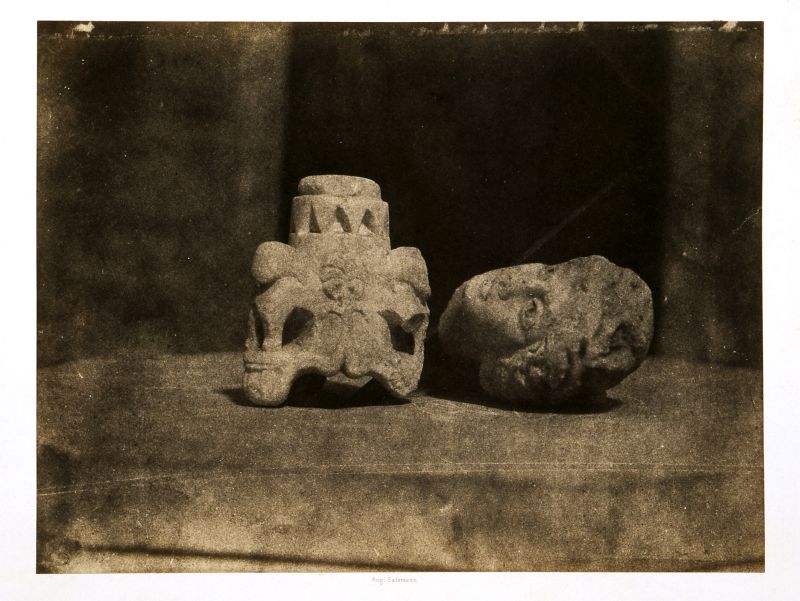
Fragments Juda ï que et Romain
An amateur archaeologist, Auguste Salzmann executed the first scientific survey of the ancient monuments of Jerusalem, in order to prove that their origins date to Herod's Kingdom, and perhaps as far back as King Solomon - and not, as was claimed by some armchair archaeologists, to Byzantine times. Besides their scientific importance, Salzmann's photographs of Jerusalem are aesthetically striking. Rarely at this early stage of photography do we see images with such visual and emotional impact. His photographs reach far beyond the subject in front of the lens, reflecting the essence of Jerusalem's sanctity. Through them we can sense Salzmann's relation to the old stones and ancient monuments, and his deep veneration for what they represent in the history of humankind. One is tempted to say that his approach was mystical and that his photographic statements are spiritual as well as visual. To understand Salzmann's photographs one has to have experienced the harsh light of Jerusalem: in a crystal-clear atmosphere it creates blindingly bright highlights of the limestone buildings and their dark, mysterious shadows. Within the limitations of the calotype, Salzmann produced stunning visual statements, displaying a deep understanding of both the medium and the subject: instead of concentrating on detail, he captured the play of light and dark. In their well-balanced compositions and delicate beauty, Salzmann's photographs of architectural details and "still lifes" of archaeological artifacts are extraordinary. His background in painting is revealed in such outstanding photographs as Fragments Judaique et Romain, which has an almost surrealist quality and seems to be visually and conceptually a century ahead of his time.

1930 Survey of Palestine map, with highlighting showing urban boundaries of Jaffa and Tel Aviv within the Jaffa Municipality.jpg
1930 Survey of Palestine map of Jaffa-Tel Aviv, with highlighting showing urban boundaries of Jaffa (green) and Tel Aviv (blue) within the Jaffa Municipality (red) For context, see: Tamir Goren (2016): Tel Aviv and the question of separation from Jaffa 1921–1936, Middle Eastern Studies, DOI: 10.1080/00263206.2015.1125340 Page 1: “Once Tel Aviv had won municipal status (the so-called Tel Aviv Township) in 1921, it strove to amend the relevant legislation by rescission of the clauses that placed it under Jaffa municipality’s supervision. In the succeeding years, this question became increasingly to the fore, and demanded a speedy solution. Together with the Tel Aviv’s ambition of independence as a Hebrew city with its own autonomous Hebrew government, some members of the township’s council did not favour separation from the mother city Jaffa. In the mid-1920s, the view consoli- dated among the town councillors that Tel Aviv’s subjection to Jaffa municipality had to be annulled, and it must be granted its deserved status as an independent Hebrew city. “ Page 3: “Tel Aviv municipality strove for full municipal rights, for the status of a municipality with all its implications, in this way enjoying absolute independence. Yet it still wished to maintain its interests in Jaffa. Most obvious was the desire not to lose the Jewish influence in the Jaffa municipality, as well as reinforcing the clout of the Jews on the municipal council. In Tel Aviv’s view, Jaffa enjoyed important status not only locally. At that time it was second in importance in Palestine only to Jerusalem, and was followed by Haifa, Safed and Tiberias.” Page 4: “…the Mandate government took a positive view of Tel Aviv’s desire for full municipal independence. But at that stage it refrained from making any changes at all in Tel Aviv’s municipal status. From the closing years of the 1920s, the authorities immersed themselves in the preparation of a new framework for the Municipalities Law, which was intended to replace the Ottoman law. So as long as the new law was incomplete, the authorities avoided any change in the municipal status of Tel Aviv. [Footnote: The new Municipalities Order was published in 1934. That year Tel Aviv gained full municipal independence, becoming a municipal corporation.]” See also: M. Gorion (Wager), Introduction to the History of Local Government in Israel (Jerusalem: University of Tel Aviv, 1957), pp.184–5 [Hebrew].

1930 Survey of Palestine map, with highlighting showing urban boundaries of Jaffa and Tel Aviv within the Jaffa Municipality (cropped).jpg
1930 Survey of Palestine map of Jaffa-Tel Aviv, with highlighting showing urban boundaries of Jaffa (green) and Tel Aviv (blue) within the Jaffa Municipality (red) For context, see: Tamir Goren (2016): Tel Aviv and the question of separation from Jaffa 1921–1936, Middle Eastern Studies, DOI: 10.1080/00263206.2015.1125340 Page 1: “Once Tel Aviv had won municipal status (the so-called Tel Aviv Township) in 1921, it strove to amend the relevant legislation by rescission of the clauses that placed it under Jaffa municipality’s supervision. In the succeeding years, this question became increasingly to the fore, and demanded a speedy solution. Together with the Tel Aviv’s ambition of independence as a Hebrew city with its own autonomous Hebrew government, some members of the township’s council did not favour separation from the mother city Jaffa. In the mid-1920s, the view consoli- dated among the town councillors that Tel Aviv’s subjection to Jaffa municipality had to be annulled, and it must be granted its deserved status as an independent Hebrew city. “ Page 3: “Tel Aviv municipality strove for full municipal rights, for the status of a municipality with all its implications, in this way enjoying absolute independence. Yet it still wished to maintain its interests in Jaffa. Most obvious was the desire not to lose the Jewish influence in the Jaffa municipality, as well as reinforcing the clout of the Jews on the municipal council. In Tel Aviv’s view, Jaffa enjoyed important status not only locally. At that time it was second in importance in Palestine only to Jerusalem, and was followed by Haifa, Safed and Tiberias.” Page 4: “…the Mandate government took a positive view of Tel Aviv’s desire for full municipal independence. But at that stage it refrained from making any changes at all in Tel Aviv’s municipal status. From the closing years of the 1920s, the authorities immersed themselves in the preparation of a new framework for the Municipalities Law, which was intended to replace the Ottoman law. So as long as the new law was incomplete, the authorities avoided any change in the municipal status of Tel Aviv. [Footnote: The new Municipalities Order was published in 1934. That year Tel Aviv gained full municipal independence, becoming a municipal corporation.]” See also: M. Gorion (Wager), Introduction to the History of Local Government in Israel (Jerusalem: University of Tel Aviv, 1957), pp.184–5 [Hebrew].

Portrait of Three Kabuki Actors
The Edo period (1603-1867) in Japan saw the rise of a wealthy urban class made up of merchants and artisans who had the means and the leisure to enjoy the diversions of the city: the Kabuki theater, the teahouses, and the courtesans of the pleasure quarters. Artists depicted popular actors, Sumo wrestlers, beautiful women, and courtesans of the Ukiyo (the "Floating World"), conveying the transitory, illusory quality of secular life in paintings and woodblock prints. Multiple woodblock prints, which could be produced quickly and inexpensively, were widely distributed. They served as souvenirs for visitors returning from enjoying the pleasures of the city: an actor print would be a memento of a famous play, while courtesans, with their coiffures and their richly patterned kimonos, were seen as fashion trendsetters and regarded much as movie stars are today. This print depicts three famous actors: (top) Ishikawa Komazo III (1764-1838) as Hachiemon; (left) Nakayama Tomisaburo I (1760-1819) in the female role (onnagata) of the courtesan Umegawa; (right) Sakata Hangoro III (1756-1795) as Kameya Chubei. This print takes its subject matter from the tragic story of the star-crossed lovers Chubei and the beautiful courtesan Umegawa, and Chubei's wealthy rival Hachiemon. In danger of losing Umegawa, the penniless Chubei resorts to theft and eventually the lovers commit suicide. The collection of Japanese art from which this print comes was amassed and donated by the late Jacob Pins, a Jerusalem artist and collector of world renown, over a period of fifty years. It is particularly strong in early prints and in pillar prints, a subject on which Professor Pins has published the definitive study.

Hassan Bek Mosque in the 1930 Survey of Palestine map, with highlighting showing urban boundaries of Jaffa and Tel Aviv within the Jaffa Municipality (cropped).jpg
1930 Survey of Palestine map of Jaffa-Tel Aviv, with highlighting showing urban boundaries of Jaffa (green) and Tel Aviv (blue) within the Jaffa Municipality (red) For context, see: Tamir Goren (2016): Tel Aviv and the question of separation from Jaffa 1921–1936, Middle Eastern Studies, DOI: 10.1080/00263206.2015.1125340 Page 1: “Once Tel Aviv had won municipal status (the so-called Tel Aviv Township) in 1921, it strove to amend the relevant legislation by rescission of the clauses that placed it under Jaffa municipality’s supervision. In the succeeding years, this question became increasingly to the fore, and demanded a speedy solution. Together with the Tel Aviv’s ambition of independence as a Hebrew city with its own autonomous Hebrew government, some members of the township’s council did not favour separation from the mother city Jaffa. In the mid-1920s, the view consoli- dated among the town councillors that Tel Aviv’s subjection to Jaffa municipality had to be annulled, and it must be granted its deserved status as an independent Hebrew city. “ Page 3: “Tel Aviv municipality strove for full municipal rights, for the status of a municipality with all its implications, in this way enjoying absolute independence. Yet it still wished to maintain its interests in Jaffa. Most obvious was the desire not to lose the Jewish influence in the Jaffa municipality, as well as reinforcing the clout of the Jews on the municipal council. In Tel Aviv’s view, Jaffa enjoyed important status not only locally. At that time it was second in importance in Palestine only to Jerusalem, and was followed by Haifa, Safed and Tiberias.” Page 4: “…the Mandate government took a positive view of Tel Aviv’s desire for full municipal independence. But at that stage it refrained from making any changes at all in Tel Aviv’s municipal status. From the closing years of the 1920s, the authorities immersed themselves in the preparation of a new framework for the Municipalities Law, which was intended to replace the Ottoman law. So as long as the new law was incomplete, the authorities avoided any change in the municipal status of Tel Aviv. [Footnote: The new Municipalities Order was published in 1934. That year Tel Aviv gained full municipal independence, becoming a municipal corporation.]” See also: M. Gorion (Wager), Introduction to the History of Local Government in Israel (Jerusalem: University of Tel Aviv, 1957), pp.184–5 [Hebrew].

Come to Palestine Poster for the Society for the Promotion of Travel in the Holy Land
Upon his arrival in Jerusalem in 1912, Ze'ev Raban was invited to join the faculty of The Bezalel School of Arts and Crafts by its founder, Boris Schatz. There he worked as director of the repousse workshop and as teacher of anatomy and decorative arts. He also served as principal designer for the applied art studios, where carpets, metalwork, ceramics, and woodwork were made for the commercial market. Raban was much influenced by the Art Nouveau and Symbolism he had seen in Munich, Brussels, and Paris, where he studied sculpture and decorative arts. These influences played a significant part in Raban's personal style, which in turned helped define what came to be known as the Bezalel style. This poster, which features an Orientalist scene of a shepherd and his beloved in a bountiful landscape within an architectural frame of an arabesque horseshoe arch, was aimed at attracting tourists to the Land of Israel. It was designed to speak to a Christian audience as much as to Jews of the Diaspora, as can be seen in Raban's choice to set the timeless idyll on the shores of the Sea of Galilee. In the distance, framed by the blooming almond tree and date palm heavy with fruit, is the snowy peak of Mount Hermon. The verse from the Song of Songs (2:11-12) set in the stones of the frame strengthens the connection to the land of the Bible. All these elements symbolize renewal and the coming of spring, emblematic of the burgeoning Zionist society. The symbolic language of this poster - the idyllic and timeless landscape untouched by modern society, the Oriental (Arab) dress and architecture, the Biblical verse and setting - was part of the ideology and aesthetic of the early Zionist movement, which aimed to strengthen the physical connection of the Jewish people to the Land of Israel.