
Interior of a Synagogue in Safed
IN COPYRIGHT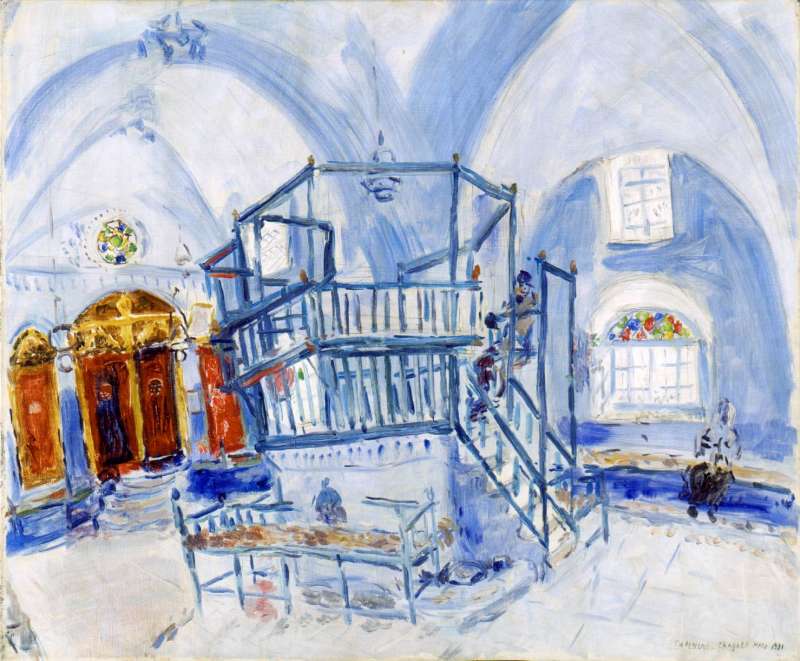
Chagall visited Israel eight times, frequently in connection with monumental projects in Jerusalem, such as his twelve stained-glass windows for the synagogue of the Hadassah hospital (1960–62) and his large tapestries and floor and wall mosaics for the Knesset building (1965–69). According to the artist, however, it was his first visit, made in 1931 with his wife, Bella, and young daughter, Ida, that left the most vivid impression. During their three-month stay, Chagall worked incessantly, recording his impressions of Tel Aviv, Jerusalem, and Safed. While in Safed, he painted several views of synagogue interiors. Interior of a Synagogue in Safed employs color and spatial distortion to create a mood of spirituality. The work is dominated by a pale blue luminosity, reflective of the strong sunlight pouring into the building and broken only by the saturated red-brown hues of the ark curtains and the flower motifs in the two visible stained-glass windows. The Ari Sephardic Synagogue still stands today, looking much as it did when Chagall fixed its image on canvas. This painting is one of the few works in Chagall’s oeuvre that describe a place that actually exists and thus can be thought of as a “document.” But it also serves as evidence of Chagall’s artistic encounter with a new world and its new, overwhelming light.
Rights evidence
http://rightsstatements.org/vocab/InC-EDU/1.0/
Public access is separate from reuse rights. Normalized by global-archive-v1; verify the original source before reuse.