
Kate Sitting
IN COPYRIGHT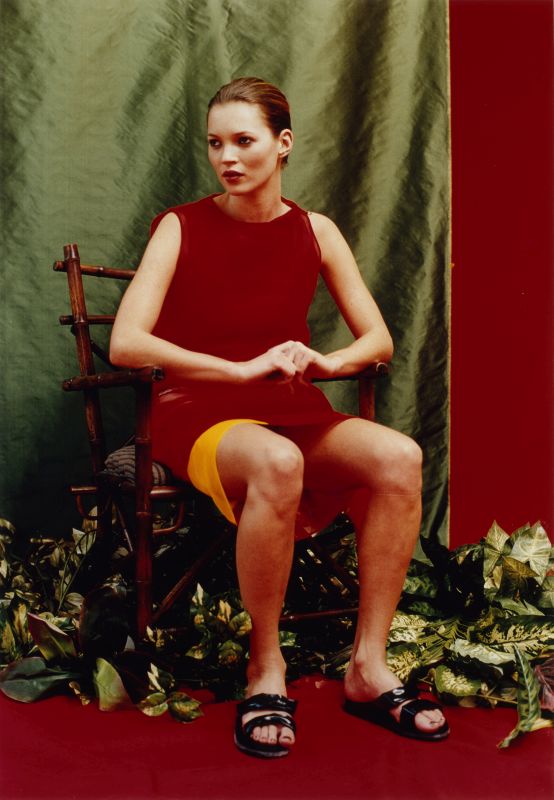
The photography of Wolfgang Tillmans, one of today’s most provocative and widely discussed artists, is characterized by the diversity of subjects, styles, and themes through which he explores the visible world. This is most probably the result of the cross-cultural relationship between his German background and the fact that he chose England as his preferred country of residence. His work is an observation of overt manifestations of contemporary society, which necessarily includes beauty, fashion, sex, and politics. It reflects the artist’s very personal mode of vision and perception of the world he lives in – and the world we live in, with its multiplicity of cultures, lifestyles, and points of view. In marked contrast to the German tradition, Tillmans does not work in predefined series or bodies of work, but rather impulsively, as the moment dictates, passing from landscape to portraiture, to still life, to abstract cameraless photographs in a seemingly chaotic progression. This mode of action is often also seen in the way he presents and displays his work, in an apparently haphazard, disconcerting fashion, which in fact is the result of a well thought out strategy. His cumulative work is, in the end, far from being a disparate mass of images, revealing itself as a consistent and logical body not devoid of political comment.Among the wide range of subject matter in Tillman’s creative work, portraiture has gained a prominent and influential place. It is a combination of fashion photography, art, and editorials for culture magazines, but above all it is about the perception of people. Many of his photographs have been mentioned in association with the documentation of youth and subcultures. Although these portraits seem to be casual snapshots – for example, his informal and apparently spontaneous photographs of gay pride activists, eco-warriors, supermodels, or clubbers – they are always the result of very carefully posed formal sittings, involving a process of complicity and collaboration between him and his sitter. The internal paradox in each of these photographs contributes in a fundamental way to the power of his images.
Rights evidence
http://rightsstatements.org/vocab/InC-EDU/1.0/
Public access is separate from reuse rights. Normalized by global-archive-v1; verify the original source before reuse.