
Graffiti Parisien
IN COPYRIGHT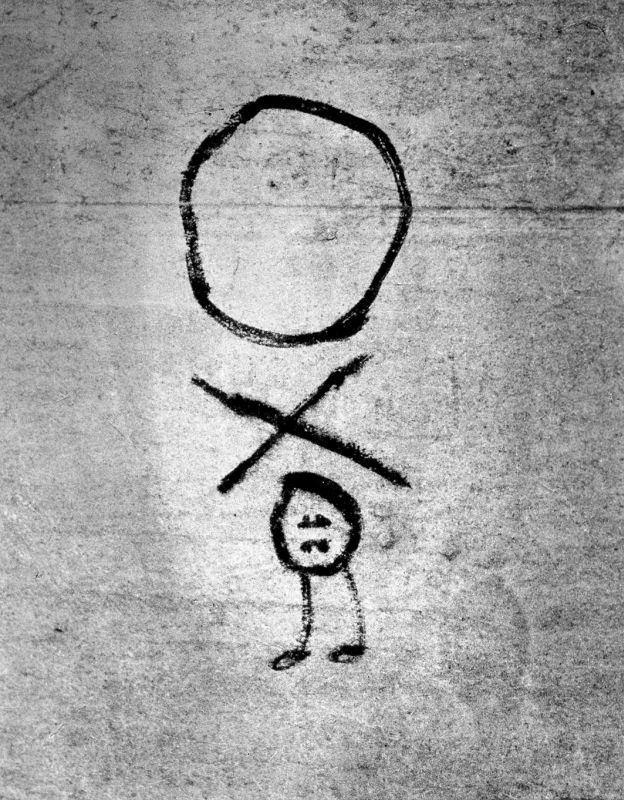
In the early decades of the twentieth century, graffiti was commonly recorded through the camera, not only in a search for form, but also as a record of reality: the haphazard scrawls and traces of human presence transformed these images into a kind of living urban archaeology. As part of his sensitivity to daily life, Brassaï became interested in these visual traces in the early 1930s. For him, graffiti was a minor art form, a popular and highly democratic type of free artistic expression. In the manner in which he captured graffiti, Brassaï presented archetypal symbols that he individually framed and isolated, thus endowing each one of them with a life of its own. By monumentalizing them, he elevated them to the ranks of the exceptional in his extensive series “Graffiti Parisien,” taken over a period of two decades in his adopted city. Many of these photographs were highly praised by the Surrealists and published in Le Minotaure. At times apparently insignificant, often cryptic or endowed with magical connotations, swaying between the abstract and the symbolic, these images are almost a catalogue raisonné of an art form yet to be discovered and studied. They are an organic and integral part of the photographer’s way of perceiving and capturing the mosaic of the human presence in the city through apparently banal scenes of daily life. By turning his attention to the odd, the unusual, or the marginal, he created a mirror image of Paris. In this sense, the graffiti series are not different from Brassaï’s photographs of the brothels and nightlife of the city.
Rights evidence
http://rightsstatements.org/vocab/InC-EDU/1.0/
Public access is separate from reuse rights. Normalized by global-archive-v1; verify the original source before reuse.