
Hebrew lesson, Palestine
IN COPYRIGHT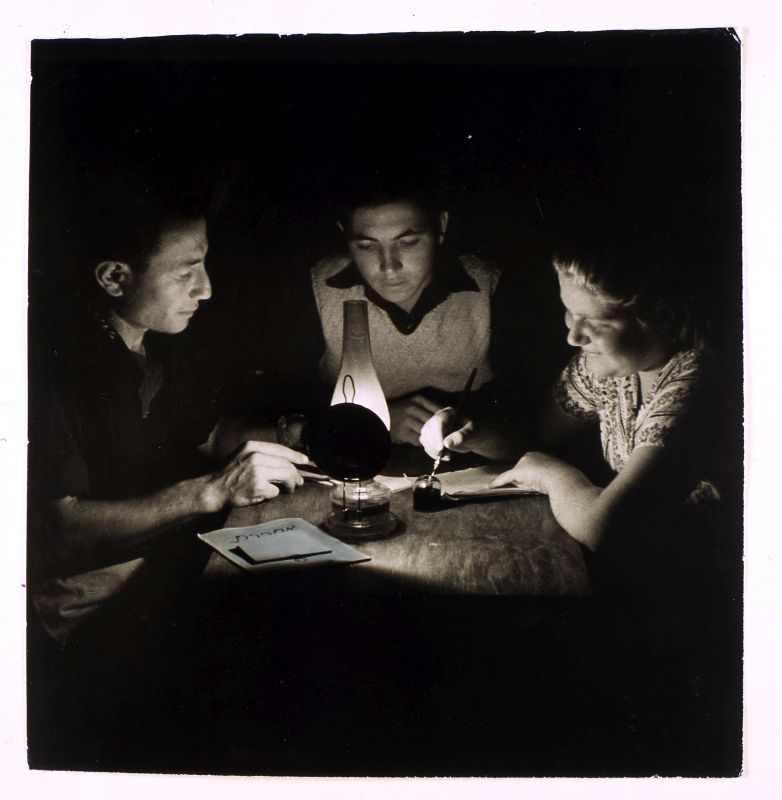
Tim Gidal belonged to the small fraternity of pioneering photographers who affected the development of modern photojournalism from the late 1920s on. This was the period when expressions such as "New Photography," "Objective Photography," and "Special Photo" were adding a new aesthetic and intellectual dimension to the medium, urging novel and different subject matter, especially in the domain of photojournalism. Like many of his colleagues at the time, Gidal took advantage of technical developments and became one of the champions of the new lightweight cameras (Leica and Ermanox) that, together with sensitive film, fostered a photoreportage of a more spontaneous nature. Gidal's photographic career, which spanned most of the twentieth century, took him to the four corners of the globe and enabled him to record many of the events that shaped the course of the century. In this sense, his images have become invaluable historical and social documents, their importance due in part to his straightforward and honest photographic style, devoid of contrived artistic effects. As part of his extensive travels he also made several trips to pre-State Mandatory Palestine, where he documented the development of the Jewish population - steadily increasing with the successive immigrations - and its lifestyle, as well as the way in which the immigrants coped with a new language and environment. The photograph Hebrew Lesson is among the finest examples of Gidal's sensitive approach and vision, while the dramatic light, deep shadows, and pose, reminiscent of Caravaggio, are a testimony to his great knowledge and appreciation of artistic tradition.
Rights evidence
http://rightsstatements.org/vocab/InC-EDU/1.0/
Public access is separate from reuse rights. Normalized by global-archive-v1; verify the original source before reuse.