
Un Effet de Soleil, Ocean no. 23
IN COPYRIGHT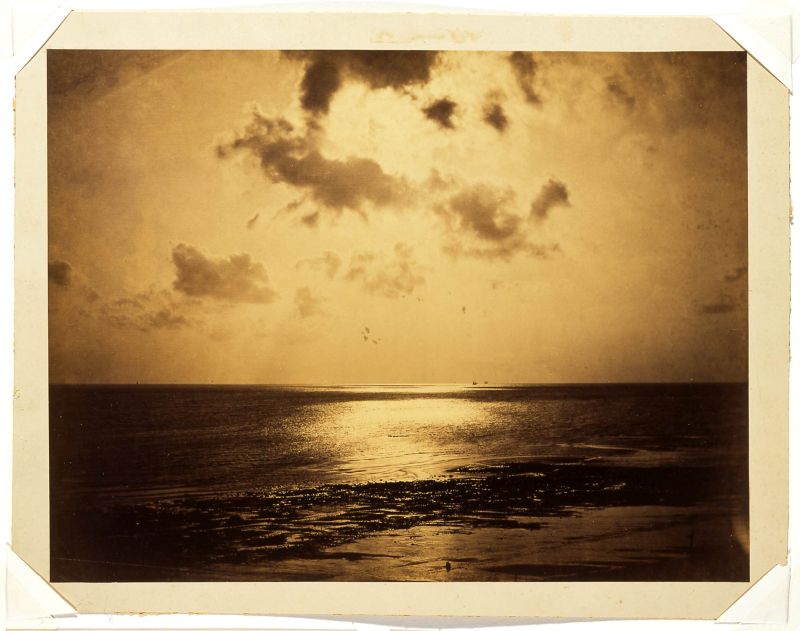
Gustave Le Gray, one of the masters of early French photography, studied painting with Paul Delaroche, and was a passionate chemist as well. Le Gray was intrigued by the new medium of photography, which he practiced with great success, becoming one of the most sought-after photographers in Paris. Le Gray revolutionized early photography both technically and aesthetically. While his creativity and versatility were highly praised, he also conducted a series of experiments aimed at improving technique, and perfected the use of the waxed-paper negative, among others. His ultimate goal was to have photography recognized as an art form, not merely as a mechanical means of reproduction. This remarkable photograph is among his masterpieces. The series of Marines Le Gray produced is both a technical and an artistic tour de force. The photographic technology of the 1860s did not allow for enough exposure latitude to capture details of sky and landscape simultaneously. To surmount this difficulty, Le Gray exposed two negatives of an identical view, one for the sky and the other for the rest of the scene. At the printing stage, Le Gray would sandwich them and thus obtain a seamless image transcribing a perfect landscape in flawless painterly harmony. This undoubtedly makes him the forefather of what was to be known later as "combination printing."
Rights evidence
http://rightsstatements.org/vocab/InC-EDU/1.0/
Public access is separate from reuse rights. Normalized by global-archive-v1; verify the original source before reuse.