
Detachable Figure: Dancer
IN COPYRIGHT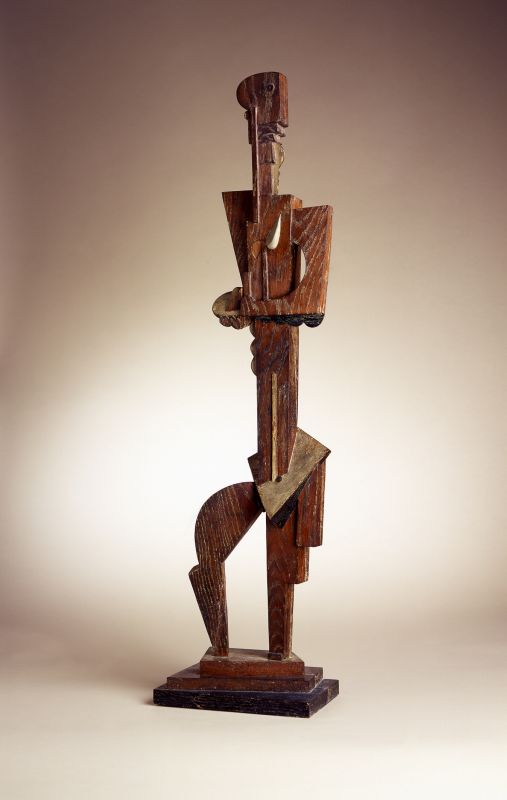
Lipchitz met Pablo Picasso in 1913 through their mutual friend Diego Rivera. As a great admirer and collector of non-Western art, Lipchitz immediately understood the potential of Cubism for his chosen medium – sculpture. Detachable Figure (Dancer) was one of Lipchitz’s first Cubist works. The combination of frontal figure and profile head most likely derived from his study of Egyptian imagery. References to African art can be seen in the use of wood, the elongation of the body, the stylized articulations, and the rhythmic amalgam of curves and angles. Lipchitz transposed the principles of Cubist painting into three-dimensional form by layering the sculpture’s distinctly separate parts and frequently joining them diagonally, which suggests multiple planes despite the relatively shallow space occupied by the work. That the figure is equally perceptible, though significantly different, from front and back encourages the viewer to move around it. To emphasize its volume, he painted some areas black and some white, such as the white slab representing the pelvis, with its black shadow. In addition, one facet of the back side is stippled with black dots – a Cubist device used, instead of more conventional shading, to differentiate planes.
Rights evidence
http://rightsstatements.org/vocab/InC-EDU/1.0/
Public access is separate from reuse rights. Normalized by global-archive-v1; verify the original source before reuse.