
Portrait of Marie Lemasson
IN COPYRIGHT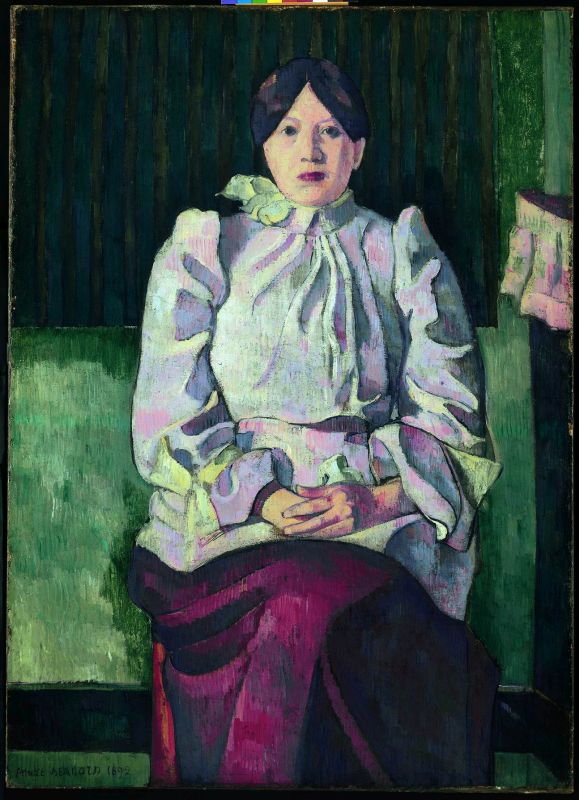
Emile Bernard was a precocious, well-educated, intense sixteen-year-old when he entered the studio of the academic painter Fernand Cormon at Paris’s Ecole National des Beaux-Arts, in 1884. His closest friends, Henri de Toulouse-Lautrec and Louis Anquetin, were fellow-students who shared his avid interest in the most recent art trends. Together they visited and discussed the exhibitions of the Impressionists, who, though beginning to achieve a measure of recognition, were still considered controversial. At the paint shop of Julien “Père” Tanguy, Bernard saw and was extremely impressed by the paintings of Paul Cézanne. He also met Vincent van Gogh, with whom he later maintained an important relationship. In literature, the young man showed a preference for the contemporary Symbolist writers and poets. A rebellious student, Bernard was expelled from Cormon’s studio. Soon afterwards, in spring of 1886, he began a walking tour of Brittany. By June he had reached Saint-Briac, on the northern coast, where he rented a room at the Lemasson family inn. He remained there through July, having been captivated by the innkeeper’s daughter, Marie. For the next six years Bernard returned each summer to Saint-Briac, but it was only during his final stay that he painted Portrait of Marie Lemasson. During that six-year period he did his most innovative work.Initially Bernard progressed from Impressionism to Pointilism and then, working with Louis Anquetin, developed a new style, in which he abandoned realism in favor of strong contours, flat areas of color and simplified forms. The result of a search for a more expressive art form, this style, called Cloisonnism, reflected the influence of Japanese art, medieval and early Renaissance art, folk art, and Symbolist literary theory. It was further developed by the close collaboration of Bernard with Paul Gauguin in 1888 at Pont-Aven. Gauguin would subsequently take the lion’s share of the credit for the Synthesist style that evolved from their work together. Portrait of Marie Lemasson was painted in the year preceding Bernard’s departure from France for more then a decade. In many ways it exemplifies the culmination of his achievement, demonstrating his ability to assimilate a wide variety of sources. Strong, dark contours delineate the color masses. The figure, elegant and monumental, is dressed in pink and brown hues, and placed against an abstract flat background of shades of green. Her face is delicately modeled while her blouse is composed of patterns of flowing, rhythmic arabesques, treated as a decorative motif. The stylized folds of the skirt and the frontal, iconic pose is reminiscent of medieval art, which was a principal source of inspiration for the artist. Recognizing the importance of this influence he wrote: “Brittany had made of me a Catholic...I was intoxicated with...old stained-glass, with hieratic tapestries, and I re-ascended the centuries...Little by little I became a man of the Middle Ages.” The following year Bernard embarked for Italy and then traveled to Samos, Istanbul, Jerusalem, and finally Egypt, where he remained almost continuously until 1904. His art is henceforth characterized by a return to traditional styles.
Rights evidence
http://rightsstatements.org/vocab/InC-EDU/1.0/
Public access is separate from reuse rights. Normalized by global-archive-v1; verify the original source before reuse.