
Winter Scene
IN COPYRIGHT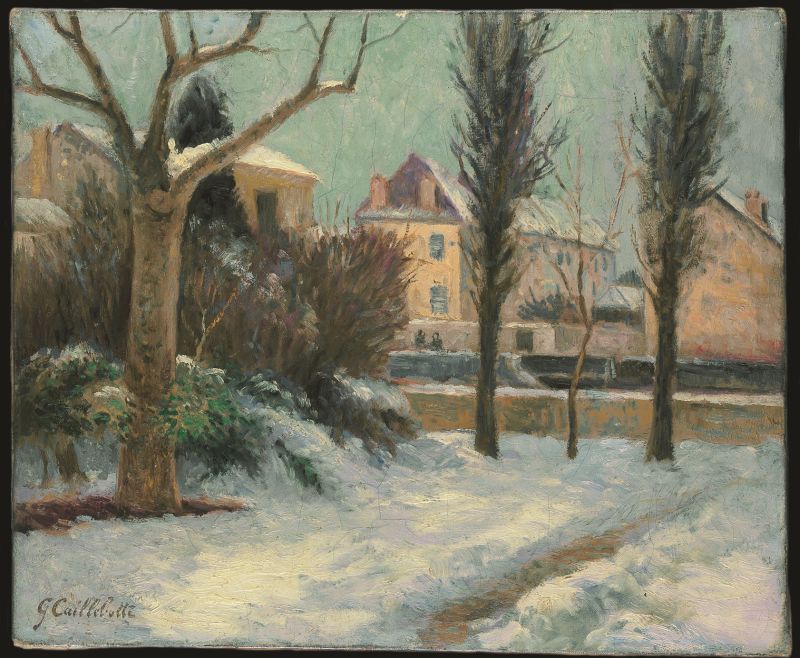
Gustave Caillebotte was born to a life of comfort in Paris in August 1848, six months after the February Revolution that gave birth to France’s short-lived Second Republic and, in its wake, the Second Empire. Gustave’s father was a textile manufacturer whose business flourished despite the political tumult. His three sons were destined for successful bourgeois careers, and Gustave did not reject his familial silver spoon. In 1869 he completed his preliminary law studies and was preparing to continue these when he was drafted into the army. The outbreak of the Franco-Prussian war in June 1870 prevented Gustave from receiving an exemption from military service, and until the end of the hostilities in March 1871 he participated in the defense of Paris. After the war, Gustave abandoned his law studies and enrolled at the studio of Léon Bonnat, an academic-realist painter. Within a few years he established contact with Bonnat’s friend Edgar Degas, and through him with the burgeoning Impressionist group. The leftist politics of the Impressionists appealed to the aspiring artist who had witnessed the horrors of the Franco-Prussian war and in May 1871 the bloody suppression of the socialist Paris Commune. Caillebotte never abandoned his family’s bourgeois values, but from the 1870s onwards—as manifest in his art and patronage—he adopted a socially conscious attitude toward his less privileged compatriots.Caillebotte’s earliest works betray the influence of Bonnat’s academic realism, but by 1875 he had started to deviate from the compositional norms of Salon painting. Caillebotte’s final break with the official art establishment was occasioned by the rejection of his large canvas, The Floor Scrapers, from the Salon of 1875. He now aligned himself with the Impressionists and between 1876 and 1882 participated actively in the group’s shows and also supported the exhibitions and his friends with generous financial grants. Caillebotte’s most innovative works date from this period. After 1882, he withdrew from Parisian public life and his association with avant-garde artists dwindled. He continued to paint, but focused on plein-air landscapes and cozy garden and river scenes that lack the social poignancy and compositional bravura of his earlier figure paintings. His late works constitute a monument to the remembrance of things past. During his career, Caillebotte painted around a dozen snowscapes, the earliest in the winter of 1874–1875 and the last four in 1887–1888. Of the latter, one can be found at The Israel Museum. It depicts a quiet, tree-lined side street either in a residential area of Paris or perhaps one of the city’s suburbs. The area has been struck by an unusually heavy winter storm, as the ground is covered by a layer of snow at least 15–20 cm thick. Within this quotidian urban vista, a narrow footpath has attracted the painter’s attention. Together with the perspectival recession of the trees and the diagonal rush of the buildings’ rooflines into the distance, the run of the footpath offers a faint memory of the monumental, architectonic axes that cut through Caillebotte’s famous figure paintings and dynamic cityscapes of the late 1870s. The leafless trees and human absence emphasize the painting’s melancholic mood.
Rights evidence
http://rightsstatements.org/vocab/InC-EDU/1.0/
Public access is separate from reuse rights. Normalized by global-archive-v1; verify the original source before reuse.