
Mother and Child
IN COPYRIGHT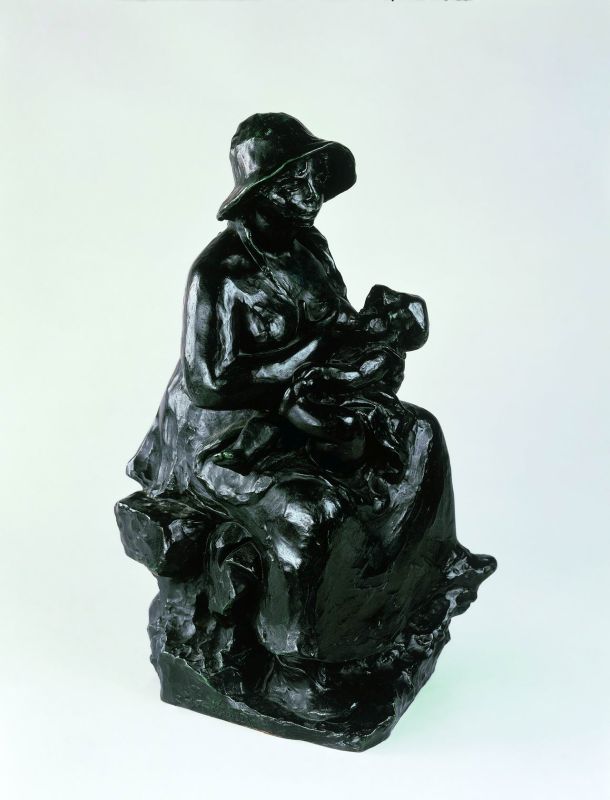
Renoir once quipped that had God not created the female breast, he might never have become an artist. Indeed, the full, womanly bosom figures prominently in Renoir's loving portrayals of women; it is also the focus of this patinated bronze sculpture of a mother nursing her baby. In early January of 1886, the painter Berthe Morisot visited the studio of Renoir, one of her closest friends, and was deeply impressed by a group of drawings and paintings depicting a woman nursing her infant son in an intimate, natural environment. When one of these paintings was shown in the June 1886 Impressionist Exhibition at Galerie Georges Petit, the ambivalent reactions it prompted were focused entirely on its style and did not relate at all to its subject matter—the act of nursing. In the nineteenth century, only lower-class women commonly nursed their own children; middle-class and aristocratic women generally employed wet nurses. It was perhaps for this reason that Renoir refrained from revealing to his friends the identity of the model for the series, although it was based on a set of drawings of 1885 depicting Aline, his companion and future wife, nursing their first son, Pierre, then six months old. Aline's rural background, which greatly attracted Renoir, also was a hindrance to their relationship which, being regarded as a mismatch, was kept secret until 1890. Aline Charigot was born in 1859 in the small town of Essoyes, the daughter of a baker and a seamstress. Having moved with her mother to Paris, the young Aline also worked as a seamstress, an occupation popular among artists looking for models. In the early 1880s she became Renoir's model and mistress, and she appears in many well-known works, often together with Pierre, and with his two younger brothers, who were born in wedlock.In his last, frail years, Renoir returned to the comforting motif of Aline nursing Pierre in this graceful sculpture, executed in bronze by his assistant, the Spanish sculptor Richard Guino, according to Renoir's instructions. As in his paintings of the 1880s, Renoir concentrated on the tenderness of the scene, but in our sculpture Aline's gaze is inward and pensive, rather than being directed at the viewer or at the infant boy nestling against her ample breast. Though withdrawn into her own thoughts, she nevertheless holds the nipple to her son’s mouth to facilitate his sucking, supporting his plump body with her right leg and propping up his back to make him comfortable. Pierre responds with a blissful smile, sucks to his heart's content, and fondles his foot in a disarmingly realistic manner. The sculpture, like the paintings on which it is based, presents Aline and Pierre as a modern version of Mary and the infant Jesus, the subject of innumerable works of art over the centuries. In one variant of this image, Mary is shown nursing, an act that seems to epitomize her role as the nurturing mother of Jesus. The fascination with this simple, everyday motif imbued with traditional and religious connotations likewise inspired Bourdelle's sculpture Maternity, also in the Israel Museum Collection. Here, too, the mother's demeanor and gaze seem pensive, but in contrast to the naturalism and detail of Renoir's sculpture, Bourdelle's rendering is fragmentary: the mother's right arm is missing, and the torso is truncated above the waist, which focuses the composition on the nourishing breast and the suckling infant. Renoir's sculpture, in contrast, presents a scene from the life of his own family. More than a modern representation of a traditional motif, then, it is an intimate work made in loving homage to Aline, created a year after her death in 1915.
Rights evidence
http://rightsstatements.org/vocab/InC-EDU/1.0/
Public access is separate from reuse rights. Normalized by global-archive-v1; verify the original source before reuse.