
The Man with the Broken Nose
IN COPYRIGHT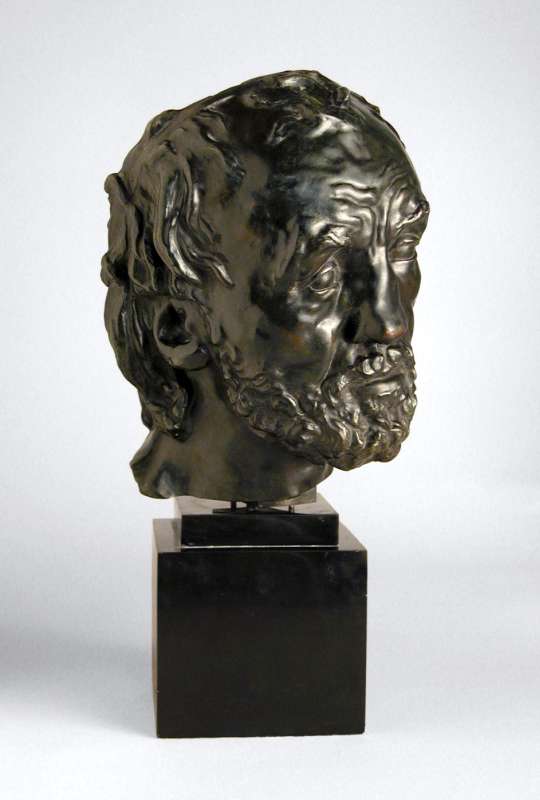
The most renowned sculptor of the nineteenth century, Auguste Rodin was revolutionary in his exploration of the human form’s expressive potential. His dynamic compositions, free handling of materials, and fragmentary representation of the body profoundly influenced twentieth-century art. Born in Paris in 1840 to a family of modest means, Rodin began to study drawing and sculpture at the Petite Ecole, a school that trained boys for careers in the decorative arts. Between the ages of seventeen and nineteen, he repeatedly attempted to gain entrance to the prestigious Ecole des Beaux-Arts, but was rejected each time. Since attendance at this school was a prerequisite for artistic success in nineteenth-century France, the rejections were devastating for the young Rodin. Between 1859 and 1870, he worked in Paris as an artisan, creating decorative objects and architectural ornaments and assisting the academic sculptor and porcelain maker Albert-Ernest Carrier-Belleuse. The Mask of the Man with the Broken Nose was Rodin’s first major sculpture. “That mask,” he said, “determined all my future work. It was the first good piece of modeling I ever did…I have kept that mask before my mind in everything I have done.” The twenty-two-year-old Rodin created this sculpture over a period of eighteen months, while working under difficult conditions in his first studio. “The winter that year was especially harsh,” he recalled, “and I couldn’t have a fire at night. The Man with the Broken Nose froze. The back of his head split off.” Recognizing the expressive potential of the fragmented, unfinished head, he decided to take artistic advantage of this mishap.As his model, Rodin had chosen a neighborhood handyman named Bibi who had an unusual, battered face. Curiously, the finished work bears a strong resemblance to portraits of Michelangelo, and pays homage to him, the most famous “man with a broken nose” in the history of sculpture. With its tilted head and asymmetrical face framed by untidy locks of hair, the sculpture has a lifelike quality, a feeling of pathos. It appears that Rodin identified with the suffering and pain of this individual who knew loss and poverty in a deeply personal way. Rejecting the customary practice of including shoulders and chest, Rodin focused the viewer’s attention exclusively on the face. Though physically flawed, the figure carries much dignity, and the narrow band around his head indicates antique sources of inspiration. Indeed, the classical sculptures Rodin studied at the Louvre were often imperfect, having suffered damage in the area of the nose. The many ridges and hollows in the figure’s face, hair, and beard already reflect the sculptor’s preference for crude and obviously worked surfaces, and create areas of luminosity and pockets of shadow. Rodin made a number of unsuccessful attempts to exhibit The Man with the Broken Nose at the Paris Salon. Only in 1875 was the more classical marble version of the sculpture finally accepted for the Salon, and the sculpture eventually became one of Rodin’s best-known works.
Rights evidence
http://rightsstatements.org/vocab/InC-EDU/1.0/
Public access is separate from reuse rights. Normalized by global-archive-v1; verify the original source before reuse.