
View of St. Cloud
IN COPYRIGHT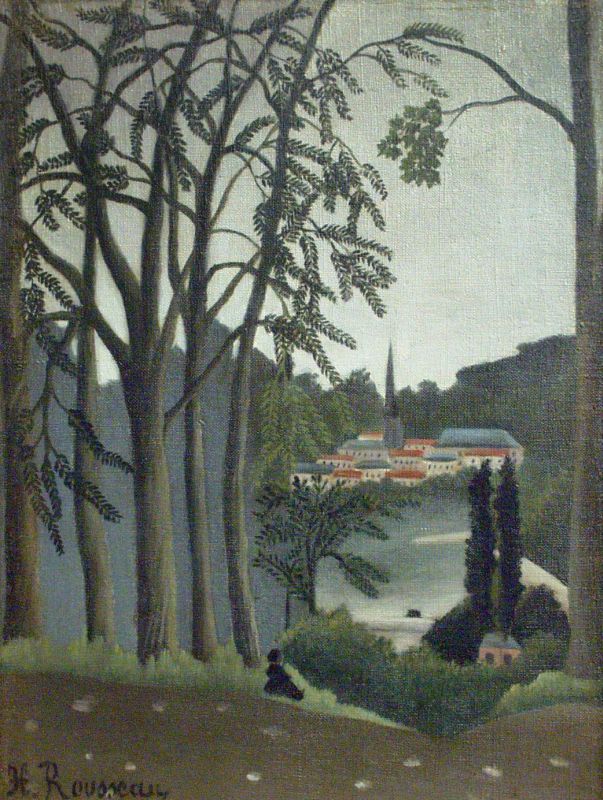
Henri Rousseau was born of petit bourgeois parents on May 21, 1844 in the medieval town of Laval. He spent his youth in Laval and at the age of nineteen joined the army. After seven years in uniform, Rousseau moved to Paris where he obtained work at the city’s customs department. Between 1871 and 1893, Rousseau worked at various customs houses that at the time encircled Paris and served as checkpoints through which all goods brought into the city had to pass. He never obtained the post of “customs officer,” as his nickname, Le Douanier, suggests. One of the great anomalies in the galaxy of modern art, Rousseau died on September 4, 1910. He was buried in a pauper’s grave only to be recovered from its anonymity through a monument erected in his honor in 1912 by Pablo Picasso, Robert Delaunay, and Constantin Brancusi. Rousseau began his career as an artist in the 1870s as an autodidact “Sunday painter.” In 1884, he started copying old master works at the Louvre and other state collections, and from 1886 until 1910 exhibited regularly at the juryless Salon des Indépendants. Both critics and the Parisian art public found his works spectacularly ridiculous, beyond the norms of both official and avant-garde art. This did not deter Rousseau from pursuing his uncompromising passion for visual creation. In fact, in order to commit himself solely to painting, in 1893 Rousseau retired from civil service and henceforth his only income was a small pension. Rousseau’s art is naïve, but in using this adjective that is ubiquitously pinned on him it is important to bear in mind that naiveté comes in many flavors. Rousseau’s is unique to him and should not be paired with, for example, the calculated primitivism of Gauguin and the Nabis. Rousseau’s art is an admixture of his professed admiration of academic painting, his lack of knowledge about the formal conventions of pictorial composition, and above all, his willingness to be guided by the lighthouse of human imagination.One landscape by Rousseau belongs to the Israel Museum’s collection. View of St. Cloud, a picture small in size but monumental in spirit, has been variously dated to 1895, 1904, and 1909. The fluid technique, stability of composition that approaches a one-point perspective, and close tonal and thematic analogy with other late landscapes, supports 1909 as the date of execution. A dreamy mood pervades this image in which giant trees with acacia leaves form a protective canopy for an ethereal figure seated on a patch of grass on a slope, from which a view opens toward the Parisian suburb of St. Cloud. Many of Rousseau’s early works are marked by an unresolved conflict between an unfolding narrative and the simultaneous absence of temporality. In View of St. Cloud the painter resolves this dilemma by depositing narrative consequentiality into the spectator’s mind. The picture, like its tiny protagonist, turns its back on us. Here Rousseau tackles—inadvertently, no doubt—one of the fundamental principles of twentieth-century art, namely that painted surfaces are not puzzles to be solved, but rather that humanity is the puzzle they embrace.
Rights evidence
http://rightsstatements.org/vocab/InC-EDU/1.0/
Public access is separate from reuse rights. Normalized by global-archive-v1; verify the original source before reuse.