
Woman Reading
IN COPYRIGHT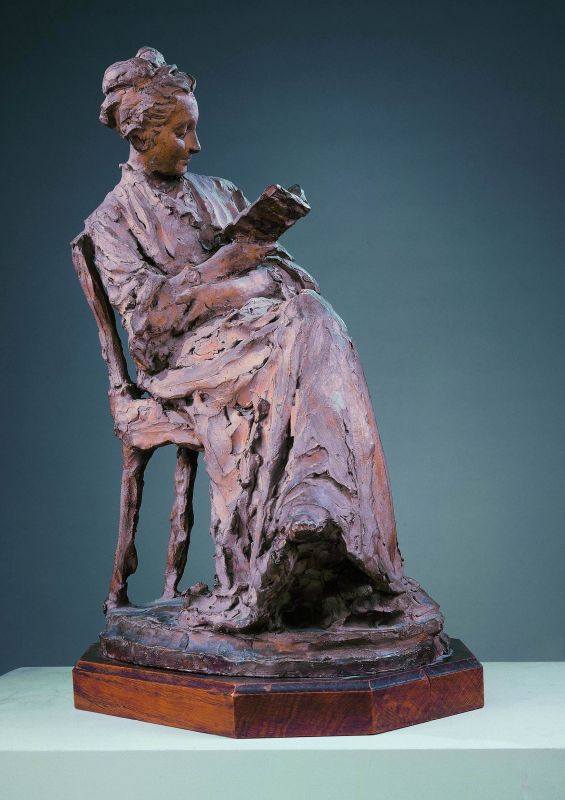
Having fled Paris in the wake of the Franco-Prussian War and the uprising of the Commune in the summer of 1871, Dalou settled down in London, where he developed an intimate-realistic style, as exemplified by Woman Reading and Peasant. The interest that he now manifests in everyday scenes marked a departure from the traditional themes of nineteenth-century sculpture, though these kinds of subjects had already begun to appear in contemporary painting, reflecting the influence of Dutch and Spanish art of the previous centuries. The idyllic bathers and shepherds Dalou’s colleagues continued to depict represented various mythological images rather than the everyday world, but the new genre grew in popularity in the 1850s and was gradually sanctioned by the conservative art establishment. The development of realistic sculpture was, however, very slow. It was only in the last quarter of the nineteenth century that it became widespread, as seen for example in a fascination with the portrayal of urban and rural laborers, as well as of landscape and animals, reflecting the influence of such new branches of science as anthropology and paleontology, which brought humans closer to the natural world. Dalou's terracotta Woman Reading, of 1874, epitomizes this new tendency in its simple motif of a seated woman engrossed in her book, far removed from mythological or historical themes. The artist's touch is palpable both in the work's impressionistic texturing—which conveys in a tactile way the folds of fabric, the hair tied in a soft bun, and the rustling pages of a book—as well as in the carefully wrought facial features. All these elements combine to create a voluminous, dynamic sculpture, rich in details, which can be glimpsed also through the open back of the chair, providing a view of the woman from additional angles.The reading motif, recurring through the ages, had been popular in Rococo art of the eighteenth century. However, unlike Boucher's Madame de Pompadour or Angelica Kauffmann's representations of women holding a small book but turning their eyes toward the spectator, Dalou's reader is serenely absorbed in her tome, oblivious to the surrounding world. This kind of figure, engrossed in a sedentary activity, appealed to Realist artists from the mid-nineteenth century onward. Reading, as well as listening to music, represented the bourgeois aspiration to education and found expression in contemporary art mainly in renderings of middle-class women immersed in these activities in the setting of their homes. Dalou's reading woman, with her drawn-back hair, demure housecoat, and poised, upright pose, embodies the polished manners taught to educated young middle-class girls of the period and clearly belongs to this social rank. These characteristics, together with the smallness of the book, suggest that she is reading a fashionable novel rather than the uplifting religious literature commonly imbibed by women of the lower classes.
Rights evidence
http://rightsstatements.org/vocab/InC-EDU/1.0/
Public access is separate from reuse rights. Normalized by global-archive-v1; verify the original source before reuse.