
Winter Day in Berlin
IN COPYRIGHT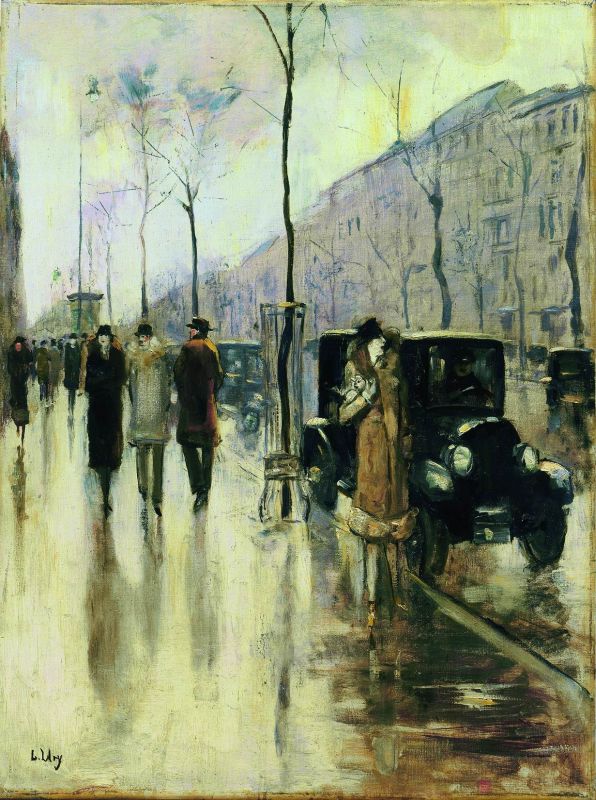
Winter Day in Berlin belongs is one of the artist’s classic Berlin street scenes. The particular street cannot be determined today, since there are no specific points of reference to be seen. The picture shows Berlin on a cold, gray winter day. The painter has captured the chill, damp atmosphere following a rainstorm. The silhouettes of the passers-by, the motor-cabs, and the bare, leafless trees are mirrored on the wet asphalt pavement of the street. The sky is clearing; patches of bright blue glimmer through the thick cloud covering. During his lifetime, Lesser Ury’s street scenes were already among his most popular subjects. They were in such great demand that he often executed several versions of the same composition. As he was not under contract to any of the Berlin galleries, there was no single organization representing his work. Collectors who wanted to buy his paintings did so at one of his gallery exhibitions or purchased them directly from the artist in his studio. There are two versions of Winter Day in Berlin in Israel, one in a private collection. These compositions show the same street scene, but their details differ. In the alternate version, only the rear of the automobile in the foreground can be seen, and a woman emerges from its back seat. In the painting belonging to the Israel Museum, the parked vehicle is shown in its entirety. The woman has just left the cab and, holding a small dog in her right arm, she proceeds along the pavement.Among his various street scenes, Lesser Ury was evidently especially proud of Winter Day in Berlin. A photograph shows him sitting on a chair in suit and vest with his palette and brushes in both hands. On the easel to the left is the already finished and signed Winter Day in Berlin. In the background one can discern The Youth, the left panel from his great triptych, Man (1898). The photo was taken in the late 1920s, thus only a few years before the artist’s death. As attested to by his elegant attire, it was hardly an impromptu shot of the artist at work. It was instead a carefully considered image that enabled the painter to present himself as he wished to be perceived. In this, Lesser Ury was following a centuries-long tradition of self-portraits by artists, in which they presented themselves among some of the finest examples of their work.
Rights evidence
http://rightsstatements.org/vocab/InC-EDU/1.0/
Public access is separate from reuse rights. Normalized by global-archive-v1; verify the original source before reuse.