
Outskirts of Maintenon
IN COPYRIGHT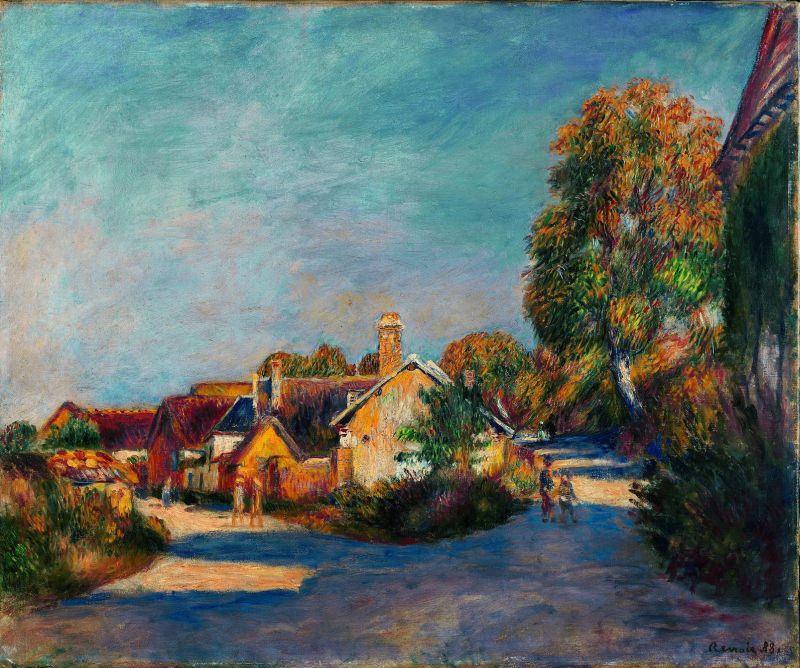
The 1880s were troubled years for Renoir, replete with changes both in his work and personal life. During the first years of the decade, the income from his portrait painting allowed him to travel to Algeria and Italy. Viewing the Renaissance masters, combined with a growing dissatisfaction with the direction of his painting, convinced him that he knew neither how to paint nor to draw. Rather than base his future on fashionable portraiture, he set about reconstructing his art on a wholly new basis. Specifically, he felt the need to emphasize draftsmanship in his paintings, to structure his compositions more carefully. The “dry style” that evolved out of this period of soul-searching and experimentation, was characterized by sharply defined linear outlines and, by Impressionist standards, a high degree of finish in all details. Many of Renoir’s patrons reacted unfavorably to this new style and this, combined with a financial crisis in France, left him once again poor. When he emerged from his “dry period” toward the end of the 1880s, a new vivacity of brushwork and richness of color pervaded his paintings. No longer interested in themes of modern life, he strove for a timeless vision, anchored in an idyllic representation of the countryside, both peopled and uninhabited. Despite political unrest and his own personal anxieties, his work now reflected only harmony and repose, and the pleasure that he wished to give and receive through painting. At the end of the decade he married Aline Charigot, his long-time mistress and the mother of his son, Pierre. Thereafter she would bear him two more sons, Jean and Claude. By then his fortune had turned and the long struggle to become a recognized master had finally been won.Outskirts of Maintenon was painted in 1888, during the pivotal time when he passed from the “dry period” toward a new synthesis. This painting has a rich texture, a free scattering of multicolored touches with no overriding order. For the sky and path Renoir employed broad strokes, while the foliage is articulated in small touches. The foremost house in the middleground is painted in pink, gold, and green hues applied in small, vibrant patches of color. The chimney of this abode divides the composition vertically in half, while the recurring diagonals of the roofs carry the eye from the upper right progressively deeper into the background. On either side of the centrally grouped houses, two paths converge on which bright sunlight alternates with deep shadows. Adults and children chat or stroll on these byways. The meeting of these two forks spans the entire width of the foreground. This area is in a shadow cast by a large building on the right, of which we see only a corner of its gable. Perhaps this is the Chateau of Maintenon, which was built for the wife of Louis XIV at the end of the seventeenth century. With his growing propensity for pastoral ambiance, it would have been typical of the artist to depict not the picturesque chateau but rather a group of modest buildings nearby. Renoir spent the month of September 1888 with his friend Gustave Caillebotte in Petit-Gennevilliers, near Argenteuil. Judging from the orange-tinged leaves and foliage, which indicate the onset of autumn, it was probably at this time that he made the short trip to Maintenon.
Rights evidence
http://rightsstatements.org/vocab/InC-EDU/1.0/
Public access is separate from reuse rights. Normalized by global-archive-v1; verify the original source before reuse.