
Study for the Portrait of Lucien Freud
IN COPYRIGHT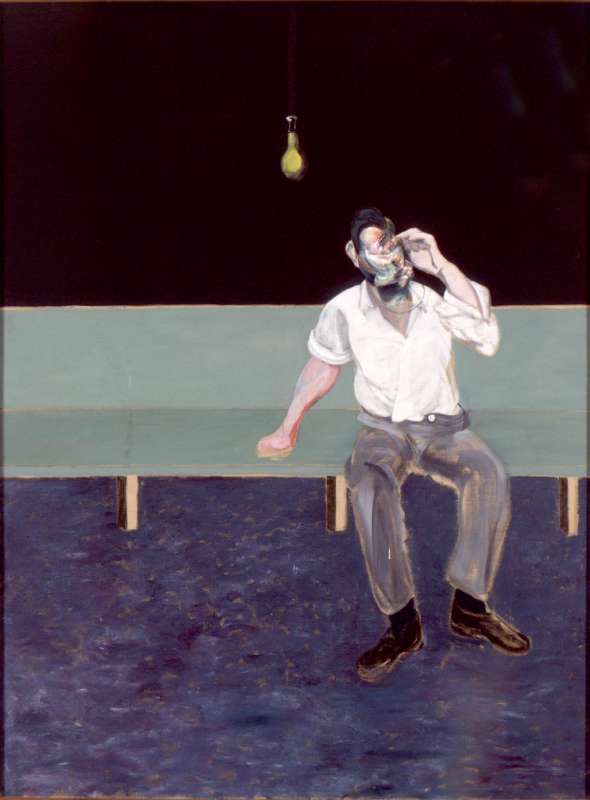
The macabre, nightmarish bodily distortions in Bacon’s paintings are reflections of the violence and desolation he saw as endemic to the human condition. Although links with Surrealism and Expressionism can be found in the artist’s work, he viewed himself as a realist. Bacon focused on portraiture, believing that “the living quality is what you have to get. In painting a portrait the problem is to find a technique by which you can give over all the pulsations of a person . . . . The sitter is someone of flesh and blood and what has to be caught is their emanation” (quoted in David Sylvester, The Brutality of Fact: Interviews with Francis Bacon [London, 1988], pp. 172, 174). Bacon’s earliest named portrait, executed in 1951, depicts his friend and fellow artist Lucian Freud. Over the following decades, he painted Freud on many occasions, sometimes in triptych format and sometimes alone, as in this portrait, which is set in a stark, austere interior defined by flat, nearly abstract, bands of color. The central band represents a hard bench, on which the figure sits uneasily, leaning on one arm and groping at his face with the other. The space is illuminated by an exposed light bulb, creating an atmosphere of threatening isolation and emphasizing the signature smearing of the face and stumplike limbs. Indeed, the setting resembles an interrogation room, and the sitter plays the role of the contorted and semiobliterated suspect.
Rights evidence
http://rightsstatements.org/vocab/InC-EDU/1.0/
Public access is separate from reuse rights. Normalized by global-archive-v1; verify the original source before reuse.