
The Little Dancer (La Petite Danseuse)
IN COPYRIGHT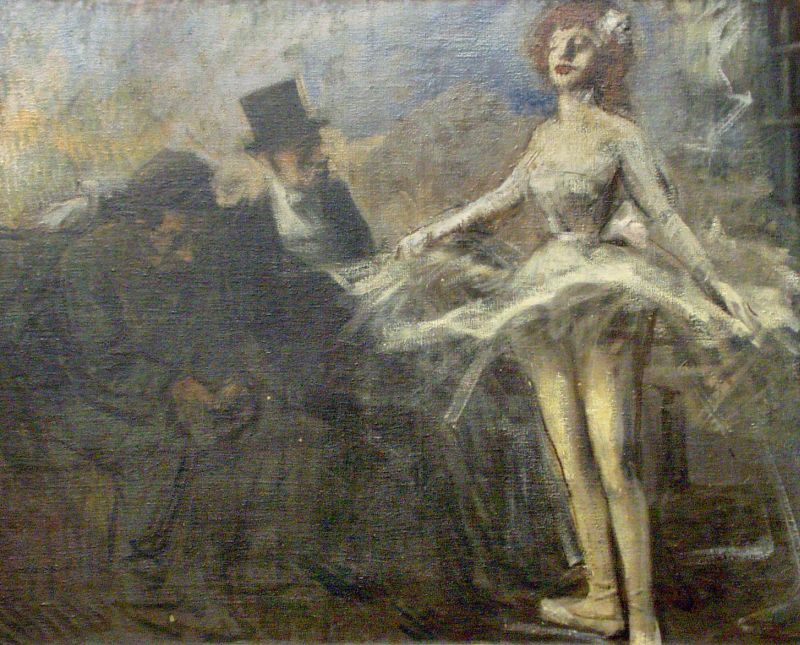
Jean-Louis Forain was one of the best-known caricaturists and illustrators of the Third Republic. His subjects ranged from the demi-monde—backstage life at the opera, cafés, and brothels—to the law courts and such political subjects as the battles and effects of World War I, and, in his last period, to religious themes. The son of a housepainter, he was, for a brief time, a student of Gérôme and Carpeaux at the Ecole des Beaux-Arts. Forain drew for a number of Parisian journals including Le Journal amusant, Le Figaro, Gil Blas, and Le Courrier Français. His illustrations for Huysmans’s book Croquis Parisiens depicted scandals of the fashionable and the underworld. Forain was influenced by Daumier and Gavarni in his caricatures and by Daumier, Degas, and Manet, in his paintings. Like Degas, his informal teacher, Forain shows elements of the dancer’s world, particularly in the wings of the theater. But while Degas was more interested in the forms of the body, the art of dance, and the world of the classroom, backstage, and performance—often with radically inventive compositions—Forain focused more on the disturbing exchanges of sex for money. There is no romanticism here. His work recalls the dark side of Emile Zola’s novels.The backstage world of poor opera dancers, and the rich, older, sometimes repugnant men in black top hats who solicit them, was an often repeated theme in Forain’s work over more than forty years, from the 1870’s to the 1920s. In the earlier works, the dancers have characteristically small, turned-up noses and round, black spots for eyes. By the mid 1880s, the dancers are more individual and corrupt, such as The Little Dancer. Forain’s brushstroke in this period is loose, nervous and gestural; his line is that of the caricaturist, coupled with such painterly effects as brown undertones and transparent blue-grey glazes and highlights for the flesh andclothes. The dry, white strokes that make up the dancer’s tutu extend beyond her figure like the lines of a force field, suggesting an aura of depravity. The flesh tones of her legs contrast with the white of the tutu. The dancer’s face is coarsely drawn and shaded, her bright red lips grimly set and her eyes downcast in a cynical, hardened expression. The top-hatted man seems to look in her direction, but his face is not delineated. His arm is curiously draped behind the dejected-looking figure of the worker who sits, hunched-over, at his side, an unusual presence in Forain’s paintings of subject’s of this type. In this disquieting, ambiguous scene, none of the three figures engage the others. Instead, the painting speaks of voyeurism and alienation. Though its date is not certain, its overall dark tonality with touches of bright color, and its chiaroscuro effects, suggest Forain’s departure from Impressionism, which occurred around 1900.Forain showed with the Independent Artists (the Impressionists), at Nadar’s studio in 1879, 1880, 1881, and with his friends Manet and Degas at the official Salon of 1884 and 1885. A prolific artist, he produced several hundred oils, more then 5,000 drawings, as well as pastels, gouaches, watercolors, and a substantial number of engravings and lithographs. The critic Louis Vauxelle compared Forain with Hogarth and Goya. Others have likened him to Toulouse-Lautrec.
Rights evidence
http://rightsstatements.org/vocab/InC-EDU/1.0/
Public access is separate from reuse rights. Normalized by global-archive-v1; verify the original source before reuse.