
Peasant
IN COPYRIGHT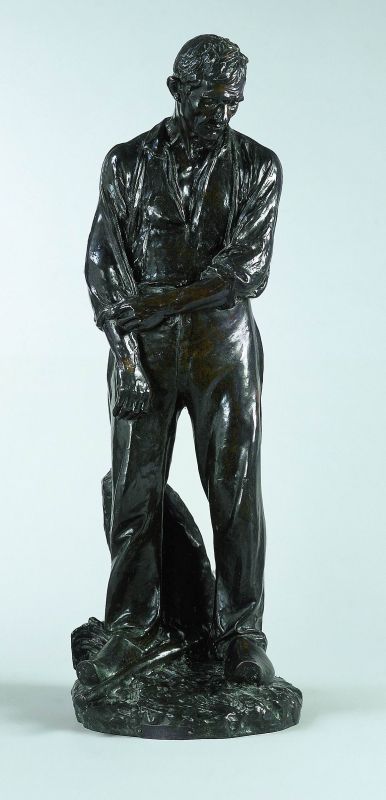
In addition to his depictions of bourgeois women engaged in such domestic activities as reading, embroidering, or knitting, Dalou produced sculptures of working-class people that likewise reflected his penchant for representing realistic everyday motifs. One of the most famous of these works, Peasant, posthumously cast in bronze in 1902, and known also as Peasant Turning up His Sleeve, represents a farm laborer in an open shirt and coarse working boots grasping a sickle. During the second half of the nineteenth century, labor came to be depicted by many artists in a heroic and monumental manner. Millet’s Sower, arduously tilling the soil, and his Gleaners, integrating harmoniously with nature, are well known examples of this genre. Dalou’s peasant, in contrast, is shown in a thoughtful moment rather than actually toiling in the fields. Rendered with authentic realism, the figure is caught unawares, recalling the absorbed countenance of the artist’s sculpture of a woman reading (no. 28). This figure, however, is dressed in the simple working clothes of the style of the period (as are Millet’s peasants). He is at one with the earth, a connection furthered reinforced by the sickle and clump of soil pressed to his right leg. In the last years of his life, Dalou produced numerous sculptures of peasants engaged in various activities that reflect the contemporary interest in labor and in the struggle of human beings against the forces of nature. At the end of the nineteenth century, such representations were ideologically and socially motivated, commemorating the contribution of common people to human subsistence and to their native lands. G. V.
Rights evidence
http://rightsstatements.org/vocab/InC-EDU/1.0/
Public access is separate from reuse rights. Normalized by global-archive-v1; verify the original source before reuse.