
Fire: Small Blacksmith Crouching
IN COPYRIGHT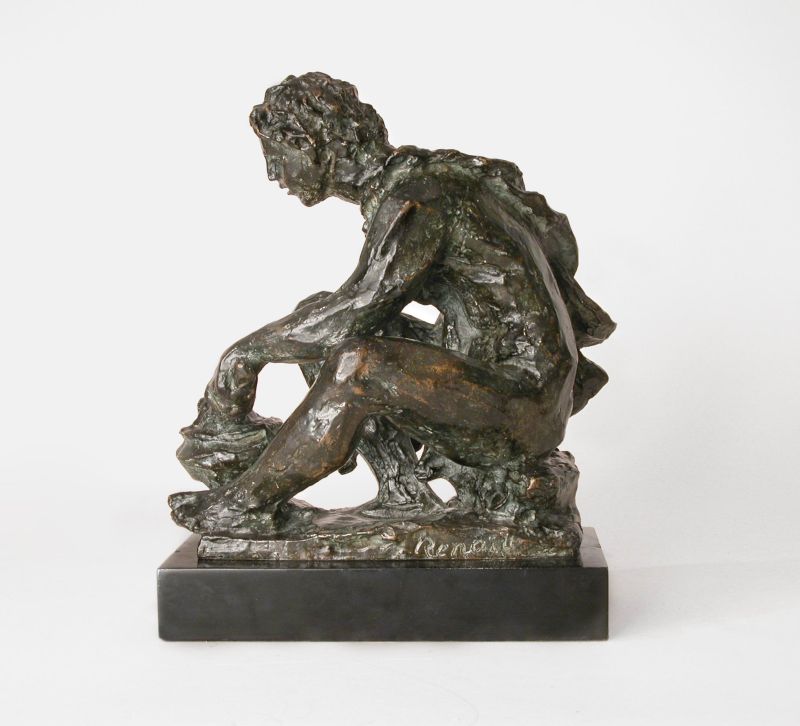
Renoir created Fire: Small Blacksmith Crouching in the same year as Small Washerwoman Crouching, and Mother and Child. All three are representative of his late years and date from a period when the artist, who had been sickly since 1888, was suffering from an ever-deteriorating state of health. At the turn of the century Renoir had become badly afflicted and deformed by gout, and by 1904 had grown so emaciated that he could barely sit. Confined to a wheelchair from 1910, once his fingers were too crooked to hold a brush, he turned to sculpture, employing the Spanish artist Richard Guino to mold the material according to his instructions and rough sketches. Renoir would propel the wheelchair around the studio and, using a baton, indicate details that had to be reworked. The late sculptures, then, though created under the artist's close supervision, were untouched by his hand. Fire: Small Blacksmith Crouching—one of the sculptures resulting from this collaboration of Renoir and his devoted assistant—represents a young man leaning forward, legs drawn up close to his chest, sitting on what may be an anvil. The man is nude but for the cloak fluttering in the wind and barely covering his genitals. His facial features resemble those of the crouching washerwoman—large eyes, schematically rendered; a straight, classical nose; a wide mouth; and wavy hair. Bending over a four-legged, flame-spewing melting pot, a large, square hammer in one hand, he lowers another tool into the fire with the other hand. The work of the blacksmith metaphorically represents the processes by which metal is forged into a utensil, and bronze into a sculpture.Like the figure of the washerwoman, the seminude blacksmith, practicing his trade in an ostensibly natural environment, is actually also an allegory of another of the traditional Four Elements—fire, symbolic of productive labor. Water and fire are similarly represented by dynamically flowing lines, notwithstanding their opposite qualities: the hot, rapid flicker of fire as against the cool, calm flow of water. Indeed, both fire and water are imbued with purifying properties, as well as either beneficent or destructive power; and when represented together, by their very natures they threaten to annihilate each other. Renoir's association of the female occupation with water and the masculine with fire evokes the antagonism between Aphrodite, the goddess of love and beauty born from the sea, and her husband, Hephaestus, the god of fire and craftsmen. In Greek mythology, Hephaestus, the divine metalworker, represented the beneficial aspect of fire as a natural source of energy, enabling man to mold metals and hence to advance from the Stone Age to the Bronze Age. Hephaestus’s marriage to Aphrodite was, however, marred by her constant unfaithfulness; so the mythological fusion of fire and water, the masculine and the feminine, was destined to vacillate between concord and discord, communion and disunion.
Rights evidence
http://rightsstatements.org/vocab/InC-EDU/1.0/
Public access is separate from reuse rights. Normalized by global-archive-v1; verify the original source before reuse.