العربية

Manuscripts and written evidence

Source records matching manuscript terminology. Cataloguing language varies: an image may represent a manuscript, while a broad historical period is not an exact production year.

752 matching records; original descriptions and titles are preserved. Search and filters →

Verify the evidence · Cite an item or clip · Rights

1565Library of Congress · Free to Use and Reuse

ʻAjāʼib al-makhlūqāt.

Paper; light cream color laid paper with no visible chain lines or watermarks; elaborate floral unwan in gold, blue and red; text enclosed in ruled border of blue and gold; numerous illustrations; black ink with rubrication and overlining; catchwords. Title from fol. 2a. Also available in digital form on the Library of Congress website. Naskh; 21 lines in written area 17 x 8.5 cm. Modern dark brown leather binding. Library of Congress. Persian manuscript, [unnumbered]. Numerous illustrations and tables on fol. 2-19; some small illustrations in body of text. Fol. 2b-238a. Manuscript. Scribe not identified. Persian. Place of writing not determined; probably Iran or Turkey.

1650Library of Congress · Free to Use and Reuse

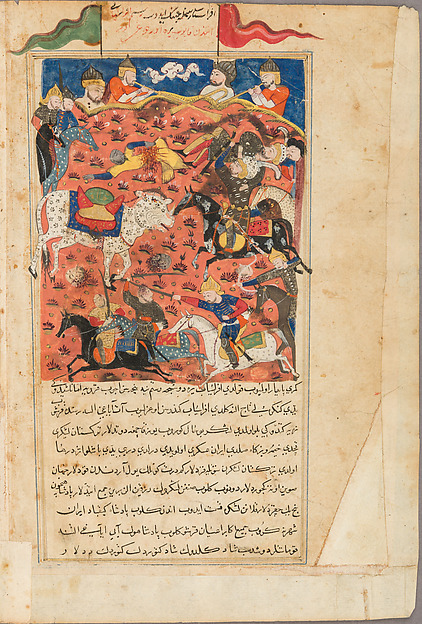
Pādishāhnāmah.

Contains a biography of Shāhjahān from his birth through the first 10 years of his reign by Qazvīnī. This work is followed by the second and third parts of Muḥammad Ṣāliḥ Kambūh's ʻAmāl-i Ṣāliḥ's history, starting with the 11th year of Shāhjahān's reign and including the wars of succession and his death. Cf, the similar composite manuscript ms. no. 566 in Bankipore, Bengal. Oriental Public Library. Catalogue of the Arabic and Persian manuscripts, v. 7 (Patna, 1921). Scribe is possibly Aqā Muḥammad Muqīm or one of his sons Sayyed Ali Khān ("Jewel Pen") or Muḥammad Jaʻfar (Kifāyat Khān). Cf. Muqīm's name at second colophon. Nastaʻliq. Place of writing most likely Northern India. 1 shamsa (title page), 2 sarlawhs, 2 colophons, and 2 appendixes. Also available in digital form on the Library of Congress website. 29 paintings including some full page, some double page. Gift of Lessing J. Rosenwald; sold at auction, Sotheby's London, December 12-13, 1929, lot 183, "Property of a Lady." LAC ddw 2022-04-07 update (1 card) Paper; text within ornamental gold borders. Manuscript. Contemporary oriental leather binding. Library of Congress. Lessing J. Rosenwald collection, 1791 Appendix includes poetry by Sayyed Ali Gilānī. Persian. Formerly marked: Rosenwald Collection ms. no. 16 LAC ddw 2022-04-07

1807Europeana · Global historical collections

Literarische Sammelhandschrift ("Anna"-Fragment, "Emilie"-Fragment [Fortsetzung])

source characteristics: Bl. 1: „Dictirtes Manuscript / (Emilie) / E XIIIB) (6.“ B. 2 (blaues Umschlagblatt): „F. Privat_Angel: / E XIIIB) 6-7“ Papier mit Prägung., z.B. auf Bl. 4, 18, 20, 22, 26, 33f., 36, 40, 42, 47, 49, 53, 187 etc. Mehrere Schreiber, auf manchen Seiten sind zwei Schreiber nachweisbar Abweichend vom sonstigen Layout Zwei-Kolumnenschreibweise bzw. Layout mit fast halbseitigem oder deutlich breitem Rand auf Bl. 49-152, 157r-166v, 189r-294r, ohne dass die zweite Spalte immer beschrieben worden wäre Papier mit ausgestanzten Ornamentmotiven Text z.T. am Seitenrand notiert. Werkimmanente Angaben zur Textordnung, vermutlich aus verschiedenen Zeiten bzw. von verschiedenen Schreibern, vgl. Bl. 32r Leerseiten, z.B. : Bl. 7v, 14v, 19v, 21v, 33v, 35v, 46v, 186v, 192v, 254v, 322v, 345v, 549v, 559 r/v Neuzeitliche Handschriften, Nachlässe, Autographen und Archivalien

1936Europeana · Global historical collections

Nr. 10: Katalog: A rich collection of manuscripts : containing early texts of Livius, Boethius, Suso ... : incunabula and early science: a unique copy of a "Biblia pauperum", first editions of Harvey 1628, Copernicus 1543, Mendel 1866; old mathematical, medical & geographical works : valuable bindings; musics comprising a German "Lautentabulatur", scarce first editions of Beethoven and Weber : coloured botanical works as De Bry, Humboldt, Jacquin, Pallas (Katalog Nr. 10)

creation/production credits: Digitalisiert nach dem Exemplar der Universitätsbibliothek Heidelberg. Die Digitalisierung wurde durch die Deutsche Digitale Bibliothek im Rahmen des von der Beauftragten der Bundesregierung für Kultur und Medien (BKM) geförderten Programms NEUSTART KULTUR ermöglicht.creation/production credits: Digital version of a copy from Heidelberg University Library. The Digitization made possible by the Deutsche Digitale Bibliothek (DDB) as part of the NEUSTART KULTUR funding program, financed by the the Federal Government Commissioner for Culture and the Media (BKM).funding: Neustart Kultur 2021

1789-04-30Library of Congress · Free to Use and Reuse

George Washington's first inaugural address, 30 April 1789.

George Washington (1732-1799) delivered his first inaugural address to a joint session of Congress, assembled in Federal Hall, New York City, on 30 April 1789. The newly elected president delivered the speech in a deep, low voice that betrayed what one observer called "manifest embarrassment." Aside from recommending constitutional amendments to satisfy citizens demanding a Bill of Rights, Washington confined himself to generalities. He closed by asking for a "divine blessing" on the American people and their elected representatives. In delivering an inaugural address, Washington went beyond the constitutional requirement of taking an oath of office and thus established a precedent that has been followed since by every elected president. Reproduction number: A115 (color slide; page 1) The Confederation Congress had set the date of the first inauguration as Wednesday, 4 March 1789. Members of the new Congress, however, were delayed in arriving in New York and were unable to count the electoral ballots as early as anticipated. Consequently, the inauguration was postponed until Congress officially notified Washington and the president-elect travelled from Virginia to New York. Subsequent inaugurations took place on either 4 March (or 5 March when the fourth fell on a Sunday), until 1937 when the Twentieth (or Lame-Duck) Amendment changed the date to 20 January (or 21 January when the twentieth fell on a Sunday).

1830Library of Congress · Free to Use and Reuse

Historia de Mexico [with] the Tovar calendar,

Part I: Historia de Mexico by Tovar, 6 copy books, nos. 2-7 of a series, ca. 266 text pp., copies from fols. 9-81. Transcribed by Elizabeth, Lady Phillipps, ca. 1862, from the original (ca. 1585) in the library of Sir Thomas Phillipps. AMs, pen and ink on lined paper. Bound in one. 8 5/8 in. x 6 7/8 in. Part II: Mid-19th C. illus (mss.) copy of the Tovar calendar (ca. 1585). Ink and watercolor on paper, captioned. Folio, stitched. 51 figures; images 1-8: 6 5/8 in. x 9 5/8 in.; images 15-51: 7 in. x 10 1/8 in. Nineteenth century transcript, in two parts, of Juan de Tovar's Historia de la benida de los yndios apoblar a Mexico (the Códice Tovar). The work was possibly based on a history of the Aztecs by the Domincan Diego Durán and contains an exchange of correspondence between Tovar and the Jesuit father Jose de Acosta concerning the composition of the manuscript; detailed information about the rites and ceremonies of the Aztecs; painted illustrations of Mexican scenes, Indian dances, etc.; and an elaborate comparison of the Aztec year with the Christian calendar. The original illustrations were by Aztec draftsmen. In Spanish. In cloth case with leather label. Also available in digital form on the Library of Congress Web site. NUCMC/vm01 Input to Voyager after 5/16/2007, date of first run of Kislak ms. records for AD NUCMC/kislak Kislak accession no.: 1994.022.01.0005 Provenance: Gift of Jay I. Kislak Foundation. Manuscript transcription of the history made by Elizabeth, Lady Phillipps, (ca. 1862) at Middle Hall from the original in the collection of her husband, Sir Thomas Phillipps. The original manuscript had formerly been in the Kingsborough Collection and is now in the John Carter Brown Library. Watercolors (ca. 1830) probably made by one of the artists Lord Kingsborough hired through the bookseller, Obadiah Rich. Jesuit missionary in Mexico. Juan de Tovar entered the Jesuit order in 1572 and spent his life doing missionary work in Mexico. He was an expert in the Nahuatl language and collected pre-Columbian Aztec codexes, conferring with natives about their meaning.

1410Library of Congress · Free to Use and Reuse

[Encyclopedic manuscript containing allegorical and medical drawings].

In the Middle Ages, medicine was very much intertwined with astrology and other nonscientific superstitions. This manuscript on vellum, produced in southern Germany around 1410, contains pen and ink drawings with explanatory texts in German and Latin. The first drawing shows the earth and seven planets. It is followed by Zodiac-man, a naked man shown with the 12 signs of the zodiac, each relating to a specific part of the body. Next are four bloodletting charts of the human body. Such bleeding charts or calendars were widely used in this period. They provided instructions on the optimum days on which to draw blood, and the body points from which to draw it. The very complexity of the instructions offered-they varied for different phases of the moon, different diseases, and different body points- lent a degree of credibility to an essentially worthless and often harmful act. The work concludes with drawings of the Tower of Wisdom (text in German); a man called Microcosmus; a man called Macrocosmus; the Tree of Virtue; Philosophy surrounded by the Seven Arts; stories showing the evil power of women; the Tree of Babylon (or vice); the Tower of Wisdom (text in Latin, on two leaves); and the Wheel of Fortune. This work is from the Rosenwald Collection at the Library of Congress. World Digital Library. An early parent to the modern almanac, these "monthly rules" are often found in astrologically focused medical manuscripts. In the Rosenwald copy, the twelve months of the year, titled in red ink for easy locating, border the central figure affectionally known to medievalists as "Vein Man." Instructions pertaining to each vein surround the body in a system of circles that connect to the pertinent point of the body via conspicuous red lines. leaf [1a] Earth and 7 planets.--leaf [1b] Zodiacal man.--leaf [2a-3b] Bloodletting charts of human body.--leaf [4a] Tower of wisdom (text in German).--leaf [4b] Drawing of man, called Microcosmus.--leaf [5b] Tree of virtue.--leaf [6a] Philosophy surrounded by the seven arts.--leaf [6a] Showing the evil power of women.--leaf [7a] Tree of Babylon (vice).--leaf [7b] Tower of wisdom (text in Latin)--leaf [8a] Continuation of leaf 6b.--leaf 8b Wheel of fortune. Label on cover: Die Kunst Ciromantia von Doktor Hartlieb ...1448, does not refer to this manuscript. Also available in digital form on the Library of Congress Web site. LC copy has anonymous armorial bookplate and the visiting card of "The Honble. Mr. Clifford" mounted on front pastedown. Library of Congress. Lessing J. Rosenwald collection, 4 Manuscript on vellum. Gothic script in black and red. Pen-and-ink drawings, some slightly colored, with explanatory text in German or Latin. Subject matter and form of presentation is similar to that in 15th century woodcuts and block books. For date and interpretation of the manuscript see the letter by F. Saxl, of April 5th, 1935, laid in. For other manuscripts of a similar type see his "A spiritual encyclopaedia of the Middle Ages: in Journal of the Warburg and Courtauld Institute, v. 5 (1942), p. 82 ff.