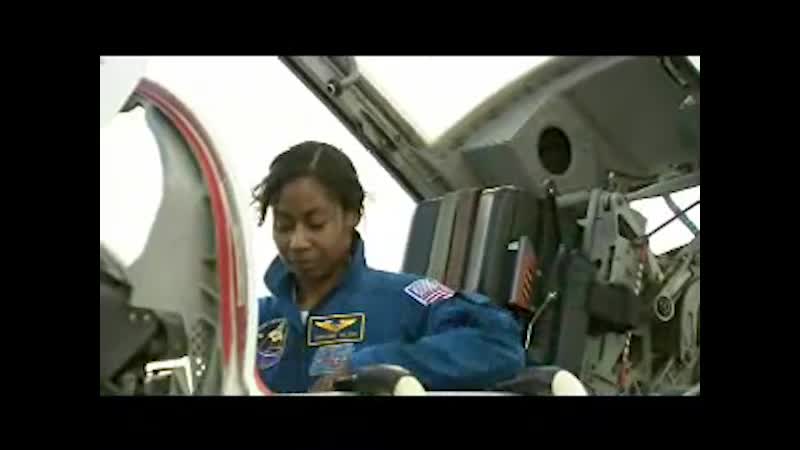
KSC-11-S-00020
Discovery's Final Mission: STS-133. The veteran space shuttle logged an incredible 39 missions, a total of 365 days in space and traveled 148.2 million miles by the end of its remarkable history.
السجلات المفهرسة تحت NASA Image and Video Library مع المعرّفات والروابط وبيانات الحقوق الأصلية. هذه المواد المستوردة وليست كامل مقتنيات المؤسسة. تحقق من المؤسسة الأصلية عندما يكون المصدر مجمّعًا للبيانات.
4,093 سجلًا مطابقًا؛ الأوصاف والعناوين الأصلية محفوظة. البحث والمرشحات →
التحقق من الأدلة · توثيق المادة والمقطع · الحقوق
Discovery's Final Mission: STS-133. The veteran space shuttle logged an incredible 39 missions, a total of 365 days in space and traveled 148.2 million miles by the end of its remarkable history.
George Hoggard served on the Flight Crew Rescue unit for the fire department at NASA's Kennedy Space Center from 1968 to 2011. He helped train Apollo and space shuttle astronauts for emergency situations and was on standby alert on seemingly countless launch days to help in a rescue.
The space shuttles are some of the most high-tech and complex vehicles ever built, but they couldn't fly without the help of an older technology: the NASA railroad at Kennedy Space Center in Florida. Every space shuttle launches with two solid rocket boosters; each booster contains four motor segments filled with propellant. The large, heavy motor segments have to take a week-long, cross-country train ride from the A
The crew of the Space Shuttle Discovery got some recent hands-on experience with equipment they will soon take into space. The Return to Flight astronauts were at NASA's Kennedy Space Center in Florida for a Payload Crew Equipment Interface Test. This test allows the astronauts to become familiar with equipment for the mission's three spacewalks. Among the payloads the astronauts inspected inside the Space Station Pr
For years, the Beach House has been the quiet, unassuming preflight retreat where astronauts have reflected as they stood on the threshold of their dream: space travel. The cozy house sits perched above the dunes at the edge of a pristine beach that stretches undisturbed as far as the eye can see. Its nearest neighbors are launch complexes.
Hi. My name is Shawn Quinn. I work at the Kennedy Space Center in the Exploration Office, and I'm the operations and requirements manager. At the Kennedy Space Center, I work in the KSC Exploration Office. I am the operations and requirements manager, and this job is in direct support of the nation's Vision for Exploration, and it's all about going back to the Moon and Mars. The return of the Space Shuttle to flight
A leak detector for the space shuttle launch pad has been miniaturized and could be used as a volcano warning system.
Mission Control in Houston gives the STS-123 crew a 'go' for the derobit burn that sets Endeavour on course for an 8:39 p.m. EDT landing at NASA's Kennedy Space Center on Mar. 26, 2008. Endeavour's 16-day flight was the longest shuttle mission to the International Space Station and included a record five spacewalks. The shuttle's seven astronauts worked with the three-member station crew and ground teams around the w
See the last exciting moments of the STS-123 mission as Endeavour approaches Runway 15 of the Shuttle Landing Facility at NASA's Kennedy Space Center in Florida. The nighttime touchdown came at 8:39 p.m. EDT on Mar. 26, 2008. Endeavour's 16-day flight was the longest shuttle mission to the International Space Station and included a record five spacewalks. The shuttle's seven astronauts worked with the three-member st
After landing on Runway 15 of the Shuttle Landing Facility at NASA's Kennedy Space Center in Florida, the STS-123 astronauts exited Endeavour and took a look at the shuttle that had carried them safely to space and back. Touchdown came at 8:39 p.m. EDT on Mar. 26, 2008. Endeavour's 16-day flight was the longest shuttle mission to the International Space Station and included a record five spacewalks. The shuttle's sev
Next on the NASA Space Shuttle Status Report: NASA announces a new launch planning window for Discovery. The NASA Space Shuttle Status Report starts right now. I'm Mark Ross, NASA test director, and this is the NASA Space Shuttle Status Report. Space Shuttle Program management announced a new launch planning window beginning July 1 and extending to July 19 for Discovery's launch to the International Space Station. Th
In this 'In Their Own Words' video, NASA astronaut Sunita Williams talks about her love of space flight, her tenure at the International Space Station and her beloved pet Gorby.
Scientists at the Space Life Sciences Lab at NASA's Kennedy Space Center in Florida are researching ways to improve the health of astronauts in space. Michele Birmele, a research scientist with Dynamac Corporation at Kennedy, is working with a bacteria bioreporter that will glow when bad bacteria are present. 'We're going to use a virus to detect whether or not there are any bad bacteria in the spacecraft environment
Hi, I'm Bill Heidtman, NASA Test Director, and this is your Space Shuttle Minute. With a major communications issue on the Hubble Space Telescope delaying Atlantis’ STS-125 servicing mission until 2009, next up for launch is space shuttle Endeavour. Endeavour is already on Launch Pad 39B where it was stationed as a potential rescue vehicle during the Hubble mission. Managers have decided to do a “shuttle shuffle” – m
The STS-120 mission astronauts participated in three days of intensive training at NASA's Kennedy Space Center for the upcoming launch of Space Shuttle Discovery.
Next on the NASA Space Shuttle Status Report: Space Shuttle Discovery roared into space and successfully completed a 12-day Return to Flight mission after more than two years of safety modifications. On August 9, Discovery glided to a picture-perfect, pre-dawn landing at Edwards Air Force Base in California, concluding its 5.8-million-mile journey. Now with focus set on another launch in spring 2006, all three of NAS
Space shuttle Atlantis rolls to Launch Pad 39A at NASA's Kennedy Space Center in Florida, one of the last prelaunch milestones before liftoff on the STS-129 mission to the International Space Station.
The six astronauts who will fly space shuttle Discovery to the International Space Station on STS-133 spent several days at NASA’s Kennedy Space Center to participate in a launch countdown dress rehearsal known as Terminal Countdown Demonstration Test, or TCDT.
Jim Kennedy, Center Director at NASA's Kennedy Space Center, invites you to join in the excitement as NASA prepares to launch the Space Shuttle Discovery on mission STS-116 to the International Space Station.
Next on the NASA Space Shuttle Status Report: A mission to build on_ With the successful completion of a trip to the International Space Station, NASA is ready once again to fly into space. 'Return to construction' of the International Space Station is under way, and the NASA Space Shuttle Status Report starts right now_ Space Shuttle Atlantis glided to a smooth predawn landing on September 21st and is now back at Ke
Safely bringing two spacecraft together as they speed through the vast weightlessness of space isn't easy. It's a challenge the U.S. Space Program has met from the Gemini missions to the International Space Station. Until now, the technology always required human assistance from astronauts. The launch of the Demonstration of Autonomous Rendezvous Technology mission -- known as DART -- could change all that. The 24-ho
As the STS-120 mission gets under way, space shuttle Discovery's external tank is jettisoned after the vehicle reaches orbit. The mission will be the 23rd assembly flight to the International Space Station and the 34th flight for space shuttle Discovery. Payload on the mission is the Italian-built U.S. Node 2, called Harmony. The 14-day mission will install Harmony and move the P6 solar arrays to their permanent posi
Space shuttle Discovery rockets off the launch pad, blazing a trail toward orbit on the STS-120 mission. The mission will be the 23rd assembly flight to the International Space Station and the 34th flight for space shuttle Discovery. Payload on the mission is the Italian-built U.S. Node 2, called Harmony. The 14-day mission will install Harmony and move the P6 solar arrays to their permanent position and deploy them.
The solid rocket boosters separate from space shuttle Discovery after providing the shuttle's initial boost toward orbit on the STS-120 mission. The mission will be the 23rd assembly flight to the International Space Station and the 34th flight for space shuttle Discovery. Payload on the mission is the Italian-built U.S. Node 2, called Harmony. The 14-day mission will install Harmony and move the P6 solar arrays to t